


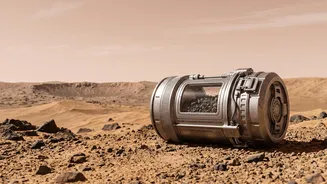
A Robot's Simple Diet: Electricity
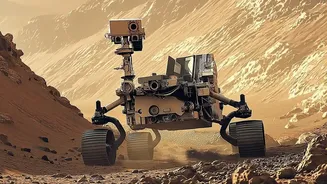
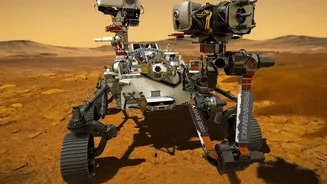
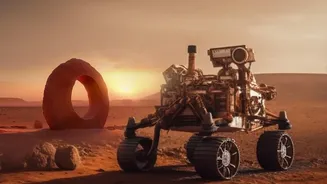
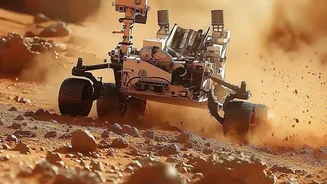
For a robotic rover like Perseverance, 'life support' is primarily about electricity. Its needs are spartan: power to run its instruments, wheels, and computer, and a data link to communicate with Earth. These machines are powered by one of two methods.
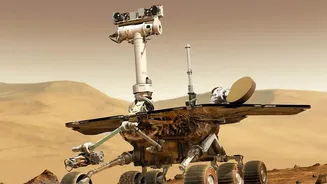
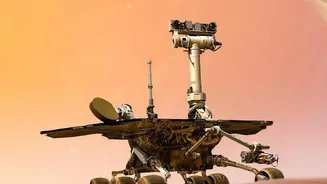
Some, like the Spirit and Opportunity rovers, used solar panels to charge their batteries. More advanced explorers like Curiosity and Perseverance use a Radioisotope Thermoelectric Generator (RTG). This device is essentially a nuclear battery, using the heat from the natural decay of plutonium to generate a steady, reliable stream of electricity for years. A robot doesn't need food, water, or oxygen. Its 'consumable' is simply power, which it generates on-site. This makes a robotic mission vastly simpler and lighter from a logistical standpoint.
The Human Burden: A Mountain of Supplies
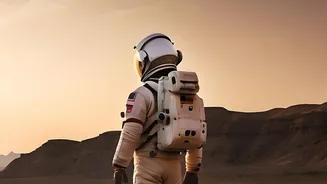
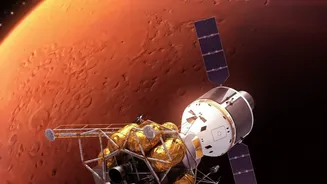
In stark contrast, a human astronaut is a complex biological engine with relentless demands. For a round trip to Mars, which could last up to three years, the numbers are daunting. Each astronaut needs roughly 1.7 to 2 kg of food per day to maintain health and energy. They also require about 3.5 litres of water for drinking and basic hygiene, and will consume around 0.85 kg of oxygen daily. When you multiply these figures by a crew of four to six people over a mission lasting hundreds of days, the total mass of required supplies quickly climbs into the tens of thousands of kilograms. Unlike a robot, a human crew cannot be powered down, and their needs are non-negotiable.
The Challenge of Packing a Pantry
Simply packing all the necessary food for a three-year Mars mission is a monumental task. The sheer weight and volume would require multiple, heavy-lift rocket launches, dramatically increasing cost and complexity. Beyond just quantity, there is the problem of quality and degradation. Over a five-year timeline (including pre-launch storage), food can lose vital nutrients like vitamins, and its taste and texture can degrade, impacting crew morale and health. Space agencies are researching everything from advanced preservation techniques to 3D-printing meals and even 'biofactories' that could use microbes to produce essential nutrients on demand during the flight.
Finding Water on a Desert Planet
Shipping all the necessary water from Earth is even less feasible than shipping food due to its mass. The solution lies in a concept called In-Situ Resource Utilization (ISRU), which essentially means living off the land. Scientists know that Mars has significant amounts of water ice locked away in its polar caps and buried underground. Future missions envision sending robotic systems ahead of the crew to land near these ice deposits. These machines would be tasked with drilling, excavating, melting, and purifying the Martian water. This water could then be used for drinking, growing plants, and even splitting it into hydrogen and oxygen to create rocket fuel for the return journey.
Making Air From the Martian Atmosphere
The Martian atmosphere is about 96% carbon dioxide—toxic to humans, but also a valuable resource. NASA has already proven it's possible to generate breathable air on Mars with an instrument aboard the Perseverance rover called MOXIE (Mars Oxygen In-Situ Resource Utilization Experiment). This lunchbox-sized device successfully pulled in the Martian CO2 and electrochemically split it into carbon monoxide and pure oxygen. While MOXIE's output was modest—generating about 122 grams of oxygen in total—it was a revolutionary proof of concept. A scaled-up version, perhaps a hundred times larger, could be sent to Mars ahead of a human crew, working like a mechanical forest to fill large tanks with breathable air and liquid oxygen for rocket propellant.
The Bottom Line: Mass, Cost, and Complexity
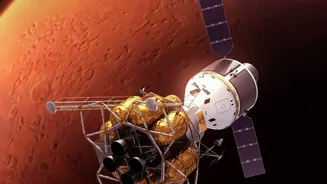
Ultimately, the comparison comes down to mass. A robotic rover might weigh one metric ton. A human mission, by contrast, requires landing a payload of 20 to 40 metric tons on the surface, including habitats, life support systems, and an ascent vehicle to get home. The estimated life support consumables alone for a crew of six can exceed 100 metric tons for the entire mission. This staggering difference in launch mass is the primary driver of the immense cost and complexity of sending humans to Mars. While robots are our indispensable scouts, the future of human exploration hinges on mastering ISRU technologies to dramatically reduce how much we need to carry from home.