







What the New Data Reveals
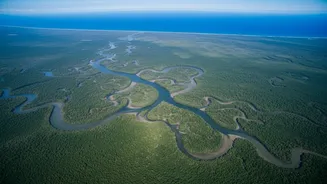
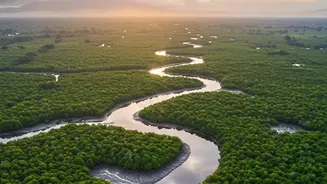
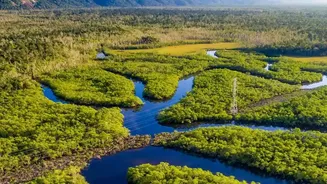
Recent studies leveraging high-resolution satellite imagery have provided an unprecedented look into the health and function of the Sundarbans, the world's largest mangrove forest. The key takeaway is that this vital ecosystem is demonstrating remarkable
efficiency as a carbon sink. While the term "accelerated" points to the immense potential unlocked by conservation, the data confirms that the forest's ability to absorb atmospheric carbon dioxide—a process known as carbon sequestration—is profoundly significant. Scientists are now able to quantify this process with greater accuracy than ever before, moving from sporadic field measurements to near real-time monitoring from space. This technological leap confirms the Sundarbans' role as a front-line defence against climate change, with some studies indicating the Indian portion alone sequesters nearly 2.8 teragrams of carbon annually. This isn't just a static picture; it's a dynamic view of a forest hard at work.
A Primer on Blue Carbon
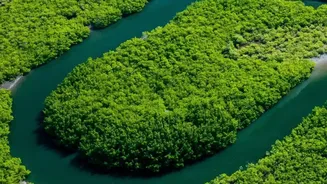
To understand why this news matters, it helps to know about 'blue carbon'. This refers to the carbon captured and stored by coastal and marine ecosystems. While all forests capture carbon, mangroves are in a league of their own. They are among the most carbon-rich biomes on the planet, punching far above their weight. Mangrove forests may only cover a tiny fraction of the world's coastlines, but they are responsible for a disproportionately large amount of carbon sequestration. The secret lies below the surface. Unlike terrestrial forests that store most carbon in their trunks and leaves, mangroves stash a huge amount in their complex underwater root systems and the surrounding soil. This oxygen-poor, waterlogged soil acts like a natural vault, locking away organic carbon for centuries, preventing it from re-entering the atmosphere as CO2.
The Eye in the Sky
So, how exactly does a satellite orbiting hundreds of kilometres above Earth measure carbon stored in a forest? It doesn't, directly. Instead, it uses advanced instruments to gather data that scientists can translate into carbon metrics. Satellites like the European Space Agency's Sentinel-2 capture high-resolution images of the Earth's surface across different light spectrums. From this data, scientists can calculate vegetation indices like NDVI (Normalized Difference Vegetation Index), which acts as a proxy for plant health and density. This information is then fed into sophisticated computer models that estimate the forest's Gross Primary Productivity (GPP)—the total rate at which plants capture carbon through photosynthesis. By combining this with data on biomass and soil, researchers can build a detailed and constantly updating map of carbon storage, a feat impossible with ground-based methods alone.
Behind the Forest's Resilience
The positive trends are not happening in a vacuum. They are supported by concerted conservation efforts. According to the Forest Survey of India's 2021 report, the country's overall mangrove cover has seen a steady increase, thanks in part to plantation drives and natural regeneration in states like Odisha and Maharashtra. While the Sundarbans faces immense pressures from sea-level rise, erosion, and human activity, these efforts provide a buffer and create opportunities for revival. The story is one of resilience. Even in degraded areas, mangroves have been shown to store more carbon than adjacent agricultural systems. This highlights that every effort to protect and restore these ecosystems yields tangible benefits for the climate. The satellite data serves as a crucial tool for monitoring the success of these conservation projects, helping to identify priority areas for restoration and protection.
Why This Matters for India
The health of the Sundarbans has implications that extend far beyond the forest itself. For India, it represents a powerful nature-based solution to help meet its climate goals. The immense carbon storage capacity means protecting this one ecosystem contributes significantly to the country's overall carbon reduction strategy. But the benefits are also local and immediate. The dense mangrove thickets act as a natural shield, protecting vulnerable coastal communities in West Bengal from the devastating impact of cyclones and storm surges. Furthermore, the ecosystem is a hotspot of biodiversity, supporting a vast array of wildlife, including the iconic Bengal tiger, and providing livelihoods for millions of people through fishing and beekeeping. A thriving Sundarbans means a more secure coastline, a richer biodiversity, and a more stable climate.