



A New Shape in the South
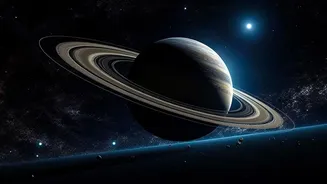
Recent observations from the Hubble Space Telescope, confirmed in early September 2026, have revealed a giant, evolving, 10-sided atmospheric wave encircling Saturn's south pole. This discovery marks the first time such a large, regular-sided jet stream
pattern has been seen in the planet's southern hemisphere. For years, astronomers searched for a southern counterpart to the famous six-sided hexagon at the north pole, which has been a stable feature for over 40 years. Even NASA's Cassini spacecraft, which orbited Saturn from 2004 to 2017, saw no hint of this formation. The decagon appears to be a recent development, with archival Hubble data showing subtle hints of the structure emerging in 2023 before becoming a distinct pattern in later observations.
A Storm Unlike Any Other
This newly spotted decagon is not just a pattern on the surface; it's a deep atmospheric structure. Observations show that the wave extends through multiple layers of Saturn's atmosphere, indicating it is a vertically significant phenomenon, not just a feature at the cloud tops. It sits within one of Saturn's powerful jet streams, similar to how the northern hexagon is contained by a jet stream. However, the decagon shows signs of being dynamic and evolving, appearing to strengthen over the last few years. This gives scientists a rare and exciting opportunity to watch a giant atmospheric pattern develop in near real-time, a process they missed with the long-established northern hexagon.
Hubble's Crucial Role
The discovery was made possible by a combination of ground-based observations from amateur astronomers and the powerful, persistent gaze of the Hubble Space Telescope. Saturn’s seasonal tilt had hidden its south pole from Earth’s view for years, but it has recently become visible again. While amateur astronomers first noticed a faint band in 2024, it was Hubble’s high-resolution images, taken as part of the Outer Planet Atmospheres Legacy (OPAL) program, that confirmed the 10-sided shape without the blurring effects of Earth’s atmosphere. By observing at different wavelengths of light, Hubble can probe different altitudes in Saturn's atmosphere, helping to reveal the decagon's three-dimensional structure.
Unlocking Atmospheric Mysteries
The biggest question for scientists is why this decagon formed now. Its recent and rapid development is a puzzle, especially compared to the steady northern hexagon. This new feature provides a natural laboratory for understanding the physics of gas giants. Scientists hope that by studying how the decagon formed and how it evolves, they can gain new insights into the powerful jet streams, deep atmospheric waves, and the forces that shape the weather on planets with thick atmospheres like Saturn. The discovery suggests that such geometric patterns may not be as unique as once thought, challenging existing models of planetary atmospheres. Future observations with both Hubble and the James Webb Space Telescope will be crucial to unlocking its secrets.