





A New Chapter for a Veteran Explorer
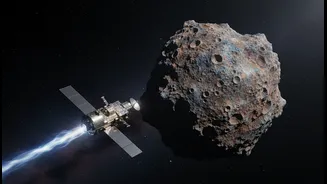
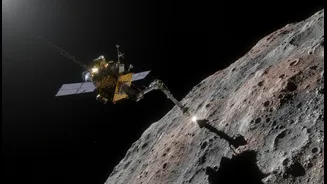
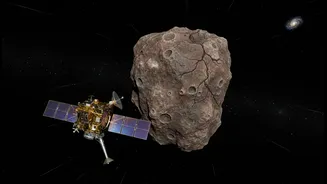
Japan Aerospace Exploration Agency's (JAXA) Hayabusa2 mission has already secured its place in history. After launching in 2014, it rendezvoused with the carbonaceous asteroid Ryugu, deployed rovers, and successfully returned precious samples to Earth
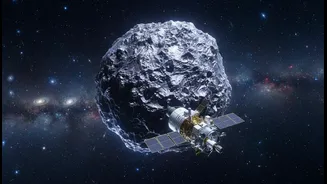
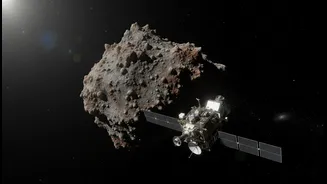
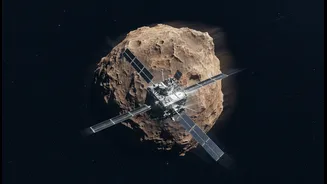
in December 2020. These samples, containing water and organic molecules, have provided invaluable clues about the building blocks of life and the early solar system. But instead of retiring, the healthy spacecraft was given an extended mission, nicknamed Hayabusa2#. Its new journey involves visiting two more asteroids, with the first major event being the flyby of Torifune in July 2026. This encounter marks a shift from the slow, deliberate work at Ryugu to a fast, technically demanding observational challenge.
The Target: What is Asteroid Torifune?
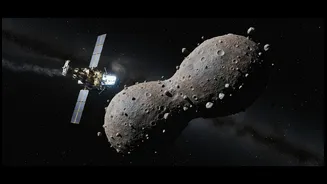
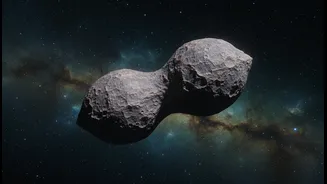
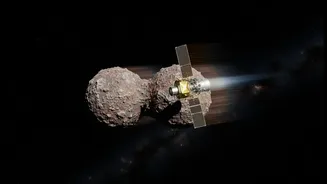
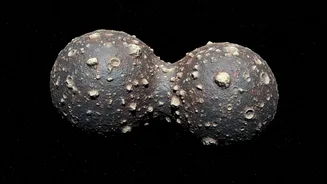
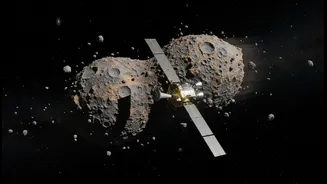
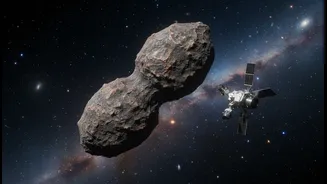
The target of this flyby is the near-Earth asteroid 98943 Torifune. Roughly 450 meters in diameter, initial ground-based observations suggested it had an elongated shape. The new close-up images from Hayabusa2 have now thrillingly confirmed that Torifune is a 'contact binary'—two separate asteroids that have gently collided and stuck together, forming a shape resembling a peanut or snowman. This makes it a fascinating object of study, as these bodies offer insights into how smaller objects in the solar system might have aggregated to form larger ones, including planets. The name Torifune, selected through a public contest, is an abbreviation of Ame-no-torifune, a divine ship from Japanese mythology known for traveling safely at high speeds.
A High-Speed, High-Stakes Maneuver
This flyby is no simple cruise. Hayabusa2 is hurtling past Torifune at a relative speed of about 5 kilometers per second, or roughly 18,000 kilometers per hour. At this velocity, the encounter is over in an instant, making navigation and data collection incredibly challenging. JAXA engineers had to guide the probe to pass extremely close to the asteroid—within a few kilometers—to get meaningful data, as Hayabusa2's instruments were designed for close-up rendezvous work, not long-distance observation. The maneuver is so precise it has been compared to hitting a small coin in Hokkaido from Okinawa. Because the asteroid is small and dark, final course corrections had to be made just days before the encounter using optical navigation.
Science Goals: Planetary Defense Takes Center Stage
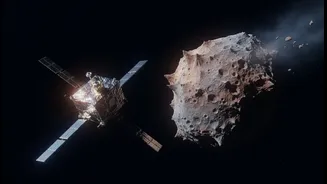
While studying the geology of a contact binary is a key goal, the primary driver for the Torifune flyby is planetary defense. Successfully navigating a spacecraft for such a close, high-speed pass demonstrates a crucial capability: the ability to precisely guide a probe toward a small, fast-moving celestial body. This is the same technology that would be needed for a kinetic impactor mission, where a spacecraft is deliberately crashed into a threatening asteroid to alter its course, similar to NASA's DART mission in 2022. By performing this maneuver, JAXA is proving it has the technology to contribute to global efforts to protect Earth from potential asteroid impacts. The data gathered on Torifune’s physical properties also helps scientists better understand the thousands of near-Earth asteroids of a similar size that are difficult to track from the ground.
What's Next for Hayabusa2?
The Torifune flyby is just one stop on a longer journey. With its remaining fuel, Hayabusa2 will now continue its voyage, performing two Earth swing-bys in 2027 and 2028 to adjust its trajectory. The grand finale of its extended mission is a rendezvous with an even more challenging target in July 2031: the tiny, rapidly rotating asteroid 1998 KY26. This asteroid is estimated to be just 11 meters in diameter and spins on its axis every ten minutes, making it an entirely different class of object to study. Each new encounter pushes the boundaries of exploration, building a library of knowledge on the diverse population of asteroids that share our cosmic neighborhood.