



The Daily Threat of Space Weather
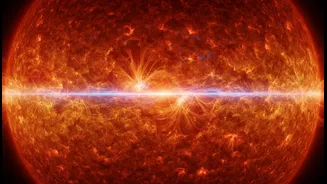
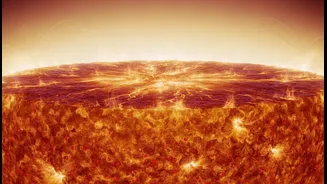
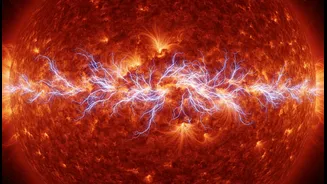
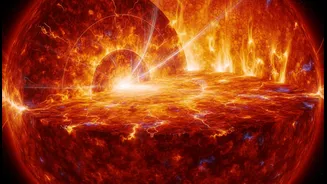
Space weather isn't about rain or snow; it's about the constant stream of particles and energy blasting from the Sun. Major events, like solar flares and coronal mass ejections (CMEs), can send powerful waves of radiation and plasma hurtling towards Earth.
While our planet's magnetic field protects us from the worst of it, strong solar storms can still wreak havoc. They can disrupt power grids, potentially causing widespread blackouts, damage critical satellites used for communication and GPS, and interfere with high-frequency radio signals essential for aviation and military operations. In an increasingly connected world, the need for accurate and timely space-weather forecasts has never been more critical.
Journey to the Sun's Mysterious Layer
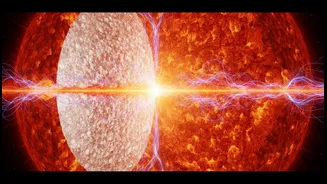
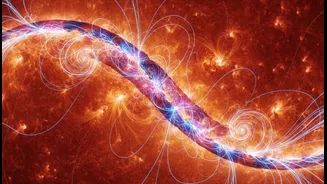
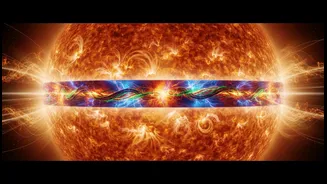
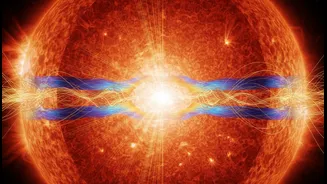
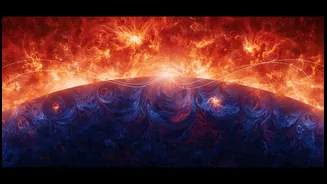
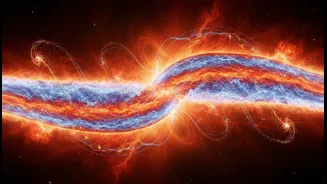
To predict the weather on Earth, we study the atmosphere. To predict space weather, scientists must understand the Sun's engine. A key part of this engine is a mysterious, incredibly thin layer deep inside the star called the tachocline. It lies about a third of the way to the Sun's core, separating two distinct zones: the rigidly rotating inner radiative zone and the churning, differentially rotating outer convection zone. For decades, scientists have been puzzled by how this boundary layer remains so thin. The tachocline is believed to be the primary location where the Sun's magnetic fields are generated and amplified through a process called the solar dynamo. These are the same magnetic fields that eventually bubble up to the surface, creating sunspots that can trigger the solar storms impacting Earth.
Meet NASA's COFFIES Initiative
This is where a NASA-supported research group comes in. COFFIES, which stands for 'Consequences Of Fields and Flows in the Interior and Exterior of the Sun', is a science center dedicated to cracking these solar mysteries. By bringing together experts and leveraging advanced computer simulations, the COFFIES team is building sophisticated models to understand the Sun's inner workings. Their goal is to connect the flows of plasma and magnetic fields inside the Sun to the solar activity we observe on the surface, ultimately leading to better predictions of the 11-year solar cycle that governs space weather.
From Solar Mystery to Better Forecasts
Recent breakthroughs from the COFFIES team have shed new light on the tachocline. Their refined computer models have successfully simulated the conditions that keep the layer so thin, a feat previous models couldn't achieve. The research suggests a dynamic interplay where the tachocline is essential for creating the Sun's magnetic field, and in turn, that fluctuating magnetic field is what confines the tachocline and maintains its thinness. By deciphering how the tachocline forms and functions, scientists can create much more accurate and physically realistic models of the solar dynamo. This fundamental understanding is the crucial next step in moving from simply observing solar activity to reliably forecasting it, giving us more lead time to prepare for potentially disruptive space-weather events.