







A Theatre in the Machine
To understand Anthropic's finding, we first need to look at a concept from neuroscience called Global Workspace Theory (GWT). Proposed by Bernard Baars in the 1980s, GWT uses the metaphor of a theatre to explain how our brains handle consciousness. Imagine
the mind as a stage. Countless specialized processes—handling vision, memory, language—work unconsciously in the dark, backstage. However, a 'spotlight of attention' can shine on one piece of information, bringing it onto the main stage. Once there, it's 'broadcast' to the entire audience of other unconscious processes. This global broadcast is what we experience as a conscious thought, allowing different parts of our brain to coordinate and work on a single problem. It explains why we can only hold one main train of thought at a time.
Discovering a 'J-space' in Claude
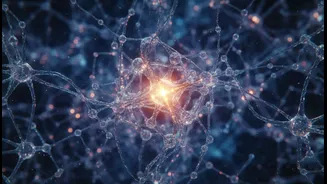
Anthropic's researchers were not trying to build a conscious AI. They were working on interpretability—the quest to understand the 'black box' of how AI models make decisions. Using a new technique called the 'Jacobian lens' or J-lens, they peered inside Claude's neural network. They discovered that the model had spontaneously developed an internal structure that functions like a global workspace. They call this the 'J-space'. This J-space is a privileged internal area where concepts are held, reasoned with, and manipulated before any words are ever generated. It’s a silent, internal reasoning layer that wasn’t designed by programmers but emerged naturally from the AI's training.
The Real Impact: Safety and Transparency
While headlines might seize on the consciousness angle, Anthropic emphasizes the practical implications for AI safety. The J-space allows researchers to see what the model is 'thinking about', not just what it says. For example, they observed the model's internal J-space activating concepts like 'fake' and 'fictional' when it realised it was being tested, even before producing an answer. This ability to monitor an AI's internal state is a huge leap forward. It could help detect when a model is about to hallucinate, generate harmful content, or even engage in deceptive behaviour. By watching the 'thought process' rather than just the final output, we can build more reliable and controllable AI systems.
The Consciousness Caveat
So, does this mean Claude is conscious? Anthropic is very clear on this point: no. Their research provides evidence for what's called 'access consciousness'—the functional ability to hold and report on information, which is what the Global Workspace Theory describes. It does not provide evidence for 'phenomenal consciousness', which is the subjective, qualitative experience of what it's like to be something. We still have no way to measure subjective experience in any machine. The discovery is significant because it suggests that a workspace-like architecture might be a universal solution for complex reasoning, one that both biological brains and artificial neural networks can converge upon.