



The Cosmic Lighthouses
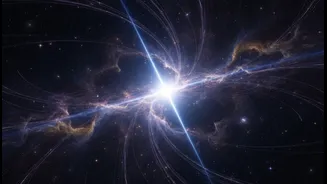
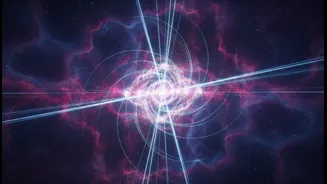
Imagine a lighthouse, its beam sweeping across the sea in a perfect rhythm. Now, imagine that lighthouse is the crushed core of a star more massive than our sun, shrunk down to the size of a city, spinning hundreds of times per second. That’s a pulsar.
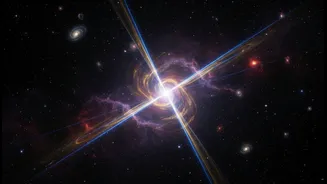
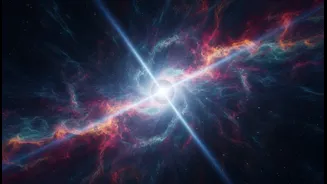
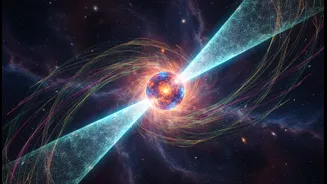
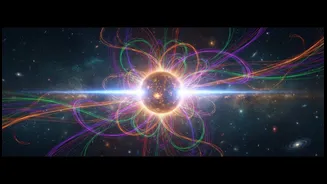
These incredibly dense objects, remnants of supernova explosions, emit powerful beams of radiation from their magnetic poles. As they rotate, these beams sweep across the galaxy, and from our perspective on Earth, we see a pulse of energy at an extraordinarily regular interval. This clockwork precision makes them perfect cosmic tools.
Building an Unconventional Map
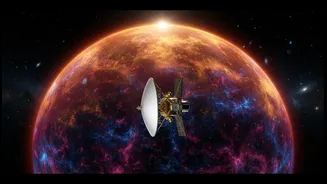
Scientists aren't using these pulsars to map locations in the traditional sense, like the famous map on the Voyager Golden Record. Instead, they are using them to map the space between us and them. By observing the light from dozens of pulsars with instruments like NASA's NICER telescope aboard the International Space Station, astronomers can measure how that light has been subtly altered on its journey through the galaxy. Specifically, they look for a twisting effect called Faraday rotation, which reveals the presence and strength of magnetic fields in the interstellar medium. By combining data from many pulsars scattered across the sky, scientists can begin to build a three-dimensional map of the Milky Way's hidden magnetic skeleton.
The Mystery of Cosmic Jets
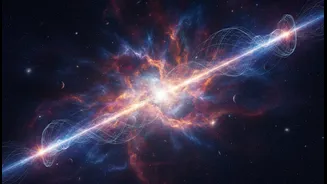
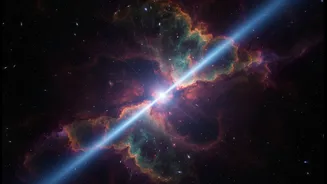
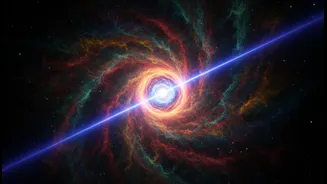
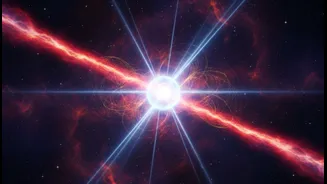
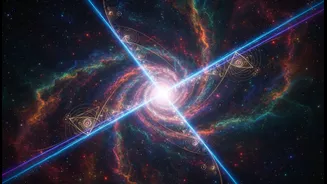
Cosmic jets are among the most powerful and spectacular phenomena in the universe. They are streams of plasma launched from the poles of objects like supermassive black holes at the centers of galaxies or newly forming stars. These jets can stretch for thousands, even millions, of light-years, blasting through space at a significant fraction of the speed of light. For a long time, the prevailing theory was that these were steady streams that broke up as they hit interstellar gas. The key question has always been: what force is powerful enough to collimate, or focus, this torrent of matter into such a narrow, powerful beam and accelerate it to such incredible speeds?
The Unseen Sculptor
The leading suspect has long been magnetic fields. The theory posits that as matter swirls into a black hole or protostar, it drags magnetic fields with it, twisting them into a tight, helical structure. This tangled, powerful magnetic field then acts like a cosmic nozzle, grabbing charged particles and flinging them outward along the object's rotational axis. The problem is that these magnetic fields are vast and invisible, making them incredibly difficult to observe directly to confirm the theory. Scientists could see the jet, but not the invisible hand shaping it.
Connecting the Dots
This is where the pulsar map changes the game. By creating a large-scale chart of the galactic magnetic field, astronomers can finally see the environment in which these jets exist. They can compare the orientation and structure of the magnetic field lines in a region of space with the direction and shape of cosmic jets emanating from nearby objects. Recent findings from NASA's IXPE mission, for example, have already confirmed that particles escaping a pulsar follow the local galactic magnetic field, lending strong support to the idea that these fields provide the scaffolding for cosmic structures. A more comprehensive pulsar map would allow scientists to test their models of jet formation on a galactic scale, moving from theoretical simulations to direct observational evidence.
A New Window on the Universe
Understanding how magnetic fields shape cosmic jets is more than just solving one puzzle. These fields are a fundamental component of our galaxy's ecosystem. They influence how stars form, guide the paths of high-energy cosmic rays, and play a role in the overall evolution and structure of the Milky Way. By developing a way to map this invisible architecture, scientists are gaining a new sense with which to perceive the universe. This technique provides a crucial new layer of data, giving context to the beautiful and violent events we can already see and helping us understand the fundamental forces that govern them.