


Let's Start with the Basics
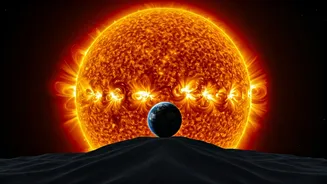
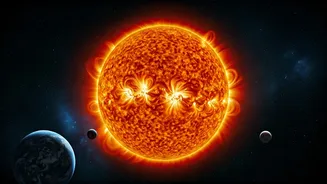
On a clear day, the sun looks like a modest, manageable circle. It doesn't seem *that* much bigger than the moon in our sky. But this is a trick of immense distance. Let's talk numbers, but make them make sense. The sun's diameter is about 865,000 miles.
That number is so large it's practically meaningless. So, let’s try this: Imagine the Earth is a standard-sized marble. On that scale, the sun would be a giant sphere about five feet tall. Now, let's talk volume. The classic factoid you hear is that you could fit one million Earths inside the sun. The actual number, according to NASA, is even bigger: approximately 1.3 million. Picture a gigantic gumball machine the size of a small building, and then try to fill it with 1.3 million individual gumballs. That’s the relationship. Our entire planet, with all its mountains, oceans, and cities, is just one of those 1.3 million gumballs.
The Cross-Country Road Trip from Hell
Volume can be tricky to visualize. A simpler, and perhaps more shocking, comparison is linear distance. The Earth's diameter is roughly 7,917 miles. The sun's is 865,000 miles. This means you could line up 109 Earths, side-by-side, just to span the diameter of the sun. Think about that. Take a mental trip from New York to Los Angeles—that's about 2,800 miles. Now imagine doing that trip, turning around, and doing it again… and again, over 300 times. That’s the distance across the sun’s surface. If you were in a commercial airplane flying at a steady 550 miles per hour, it would take you more than two months of non-stop flying to cross the face of the sun. A trip across Earth at that speed would take less than two days. It’s the difference between a weekend trip and dedicating a season of your life to travel.
The Ultimate Heavyweight Champion
Size is one thing, but mass is where the sun truly flexes its dominance. When we talk about mass, we're talking about the sheer amount of *stuff* that makes up an object. And in our solar system, the sun is basically everything. The eight planets, all their moons, every asteroid in the asteroid belt, the icy bodies in the Kuiper Belt, and every comet—all of it combined—accounts for a measly 0.14% of the total mass in the solar system. The sun alone makes up the other 99.86%. It's not so much a system of equals as it is a gravitational dictatorship. Everything else, including our home, is effectively just leftover dust and gas that happened to be floating around after the star at the center of it all formed. The sun's gravity is what holds this entire system together, keeping Earth in a perfect, life-sustaining orbit.
But Wait, Our Sun Is... Average?
Here's the final twist that really recalibrates the mind. After contemplating the sun's unimaginable scale compared to Earth, you might think it's a giant of the cosmos. It’s not. On the galactic stage, our sun is a G-type main-sequence star, often colloquially called a yellow dwarf. It's a perfectly respectable, stable, and average-sized star. There are stars out there that make our sun look like a grain of sand next to a beach ball. Take the hypergiant star UY Scuti. Its radius is estimated to be about 1,700 times that of our sun. If you were to replace our sun with UY Scuti, its surface would extend out past the orbit of Jupiter, swallowing Mercury, Venus, Earth, Mars, and the asteroid belt whole. You could fit nearly 5 billion of our suns inside UY Scuti. Suddenly, the star that can hold 1.3 million Earths feels humblingly small.