






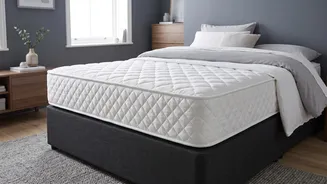
The search for a perfect mattress can feel overwhelming. For spring mattresses, a key decision comes down to a classic conflict: the lively bounce many people love versus the stillness needed to avoid waking a partner. Understanding this trade-off is the secret
to a better night's sleep.
Motion Transfer: The Wiggle Factor
Motion transfer is the term for how movement travels across a mattress surface. If your partner getting out of bed feels like a minor earthquake on your side, you're experiencing high motion transfer. For anyone who shares a bed, whether with a partner, child, or pet, this is a critical factor. Mattresses with poor motion isolation can lead to frequent sleep disruptions, as every toss and turn from one person is felt by the other. Materials that absorb energy, like memory foam, are known for excellent motion isolation because they stop movement at its source. Traditional spring mattresses, however, have a reputation for amplifying these disturbances.
Bounce: The Push-Back You Can Feel
Bounce, also known as responsiveness, is how quickly a mattress surface returns to its original shape after you move. A mattress with good bounce feels lively and makes it easier to change positions, get in and out of bed, and avoid that 'stuck' feeling some people dislike in slow-responding foams. Many sleepers who grew up with traditional innerspring beds prefer this responsive feel. It provides a feeling of being 'on top' of the mattress rather than sinking into it. This push-back from the coils offers a supportive and dynamic surface.
The Core of the Conflict: Interconnected vs. Independent Coils
The trade-off between motion transfer and bounce is rooted in how the internal springs are constructed. Traditional spring mattresses often use interconnected coils, where the springs are linked together by wires. The two most common types are Bonnell and continuous wire coils. In these systems, when one spring compresses, it pulls on its neighbours, causing motion to ripple across the entire bed—much like a wave in a pond. This interconnected design creates a unified, bouncy surface, but it's also the primary cause of high motion transfer. The bouncier the system, the more movement you're likely to feel.
The Modern Solution: Pocketed Coils
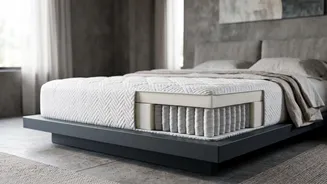
To solve the motion transfer problem, manufacturers developed pocketed coils, also known as Marshall coils. In this design, each spring is individually encased in a fabric pocket. Because the coils aren't directly wired to each other, they can move independently. When you press down on one area, only the springs directly beneath the pressure compress, which dramatically reduces motion transfer to other parts of the bed. This makes pocket coil mattresses a far better choice for couples or light sleepers. They manage to provide a good level of supportive bounce without the disruptive side effects of older spring systems.
Finding the Best of Both Worlds : Hybrid Mattresses
For those who refuse to choose between motion isolation and bounce, the hybrid mattress offers a compelling compromise. Hybrids combine a support core of pocketed coils with comfort layers made of memory foam, latex, or other materials on top. This construction aims to deliver the best of both worlds : the coils provide the responsive support and airflow of a spring mattress , while the foam layers absorb movement and offer pressure - relieving contouring . A well - designed hybrid can feel responsive and easy to move on while still preventing a partner ' s movements from disturbing your sleep .
How to Choose Your Perfect Balance
When shopping for a spring mattress , your personal needs should guide your decision . If you sleep alone and love a traditional , bouncy feel , an interconnected coil system like Bonnell might be a perfectly fine and affordable option . However , if you share a bed and are easily disturbed by movement , prioritizing a mattress with pocketed coils is non - negotiable . Don ' t just rely on the marketing terms ; ask about the coil type . The number of coils and the wire gauge ( thickness ) also play a role in support and durability , but the fundamental difference between interconnected and pocketed coils will have the biggest impact on your nightly experience .