






The Promise of a Personalised Co-Pilot
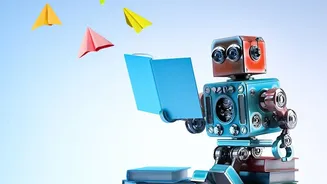
The most significant advantage of AI in education lies in its ability to personalise learning for every student. Imagine a digital tutor that adjusts the difficulty of maths problems in real-time based on a student's answers, or a reading program that provides
vocabulary support for complex texts. These adaptive learning platforms can analyse student performance, identify knowledge gaps, and offer targeted support, ensuring each learner is challenged but not overwhelmed. This frees teachers from the impossible task of manually creating dozens of lesson variations. Instead of spending hours on routine administrative work like grading multiple-choice tests or tracking attendance, educators can dedicate their time to what truly matters: engaging directly with students, fostering discussion, and providing mentorship.
Why Replacement is Not the Answer
Despite its power, AI lacks the essential human qualities that define great teaching. Education is not merely about information delivery; it's about building relationships, inspiring curiosity, and developing social-emotional skills. Teachers can read a classroom, sense when a student is struggling despite being quiet, and adapt their approach with empathy—abilities far beyond any algorithm. An over-reliance on technology risks creating an environment of isolation, where students interact more with screens than with their peers and mentors. This can hinder the development of crucial soft skills like collaboration, communication, and critical thinking. Experts warn that using AI to simply generate answers can stifle the very cognitive effort and problem-solving that leads to durable learning.
AI as the Teacher's Assistant
The consensus among educators is that AI should serve as a powerful assistant, augmenting a teacher's abilities rather than making them obsolete. For instance, AI tools can help draft lesson plans, create practice questions, or even generate newsletters for parents, saving valuable time. This allows teachers to focus on higher-order tasks, such as designing creative projects that challenge students to apply their knowledge in novel ways. AI can also be an invaluable tool for inclusion, offering real-time translation for multilingual learners or speech-to-text features for students with disabilities, thereby expanding access to grade-level content. In this model, the teacher's role evolves from a simple lecturer to a facilitator of learning, guiding students as they use technology to explore, create, and collaborate.
Navigating the Risks and Setting Rules
Integrating AI into classrooms is not without challenges. Issues of data privacy, algorithmic bias, and the potential for misinformation are significant concerns that must be addressed. An AI system is only as good as the data it's trained on, and inherent biases can perpetuate inequalities in the classroom. Furthermore, both students and teachers need to develop a new kind of digital literacy to critically evaluate AI-generated information instead of taking it at face value. For these reasons, educational institutions must establish clear policies and ethical guidelines for AI use. The goal is to ensure technology supports core learning objectives and is accessible to all students, without compromising safety or educational quality.