







An Unexpected Field of Brimstone
For years, scientists have known that Mars is a sulfur-rich planet. But the sulfur Curiosity and other missions had found was always locked away in minerals called sulfates, which are compounds of sulfur and oxygen formed when ancient water evaporated.
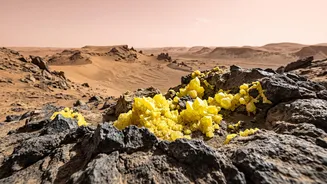
This new discovery was completely different. It wasn't just one rock; the rover had stumbled upon an entire field of stones made of startlingly pure sulfur, scattered across an area of about half an acre. Project scientists were stunned. Ashwin Vasavada, Curiosity's project scientist at NASA's Jet Propulsion Laboratory, compared the find to discovering an oasis in a desert. The sulfur simply shouldn't have been there, and its presence posed a major new puzzle.
Why Is Pure Sulfur So Puzzling?
The mystery deepens when you consider how elemental sulfur typically forms on Earth. Here, large deposits are most often associated with active geological processes, like the intense heat of volcanic vents or hydrothermal hot springs. These are environments where sulfur-rich gases and fluids are processed under specific temperatures. The problem is, there is no obvious evidence for that kind of high-temperature volcanic or hydrothermal activity right where Curiosity found the sulfur in Gediz Vallis, a channel carved into the side of the 5-kilometre-tall Mount Sharp. The rocks themselves were also noted to be remarkably fragile, suggesting they formed right where they were found rather than being transported from elsewhere. So, if not by heat, how did this strange sulfur field come to be?
Theory 1: Trapped Gases From Ancient Volcanoes
Two recent scientific papers have offered compelling, non-biological explanations. The first hypothesis, published in the journal Science, points to the ghosts of Mars's volcanic past. Researchers suggest that roughly three billion years ago, volcanic activity deep underground released sulfur-bearing gases like hydrogen sulfide and sulfur dioxide. Instead of venting to the surface, these gases became trapped in the subsurface, possibly within ice. Much later, as wind and water carved out the Gediz Vallis, the overlying rock eroded away. This released the immense pressure, allowing the trapped gases to escape and react with each other, depositing pure elemental sulfur without needing high heat at the surface.
Theory 2: A Cool Chemical Cocktail
A second study, published in Geophysical Research Letters, proposes a different path that relies on water, not gas. Scientists demonstrated in a lab that you can create elemental sulfur at room temperature through a simple chemical reaction. They mixed dissolved sulfide with chlorate—a compound of chlorine and oxygen thought to have been present in ancient Martian water—in an acidic solution. The result was the formation of tiny yellow sulfur crystals. Researchers found that the concentration of chlorate was key; lower levels favoured the production of pure sulfur, while higher levels produced the more common sulfates. This suggests that if the conditions were right in Mars's ancient lakes or groundwater, fields of pure sulfur could have formed without any volcanic heat at all.
A New Window Into Mars's Past
While scientists debate which theory is correct, they agree on one thing: this discovery does not point to ancient life. On Earth, some microbes can produce elemental sulfur, but these new studies show that purely geological processes can easily explain the find. Instead, the sulfur field provides a fascinating new look into the ancient Martian environment. It reveals that the planet's chemical history was far more diverse and complex than previously understood. The presence of these fragile rocks, preserved for potentially billions of years, speaks to an incredibly arid environment since their formation. This accidental discovery gives scientists vital clues about everything from underground gas movements to the specific chemistry of water on a young Mars.