


A Crisis of Timing
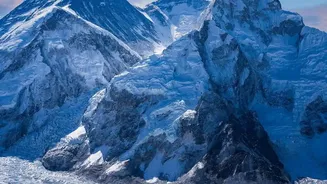
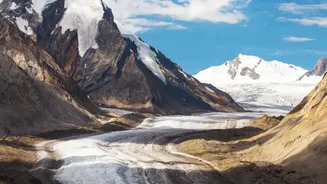
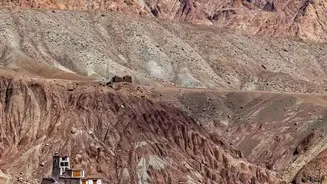
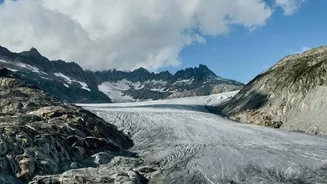
Ladakh, a region nestled in the Himalayas, is a cold desert that receives less than 50 millimetres of rainfall annually. For centuries, its communities have depended on a delicate natural cycle: the slow melting of glaciers to provide water for drinking
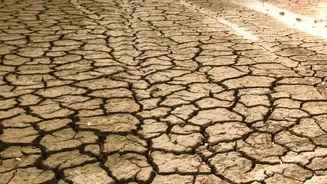
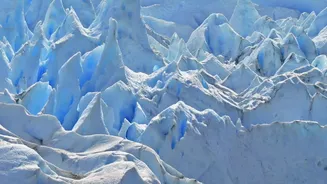
and agriculture during the crucial spring and summer months. However, climate change has broken this ancient rhythm. Warmer winters cause glaciers to melt faster and earlier, meaning much of the precious water flows away unused long before the spring sowing season begins. This creates a paradox: an abundance of water in the cold months when it's not needed, and a severe scarcity in spring when farmers need it most. This seasonal water gap threatens livelihoods and food security across the region.
An Idea Frozen in Time
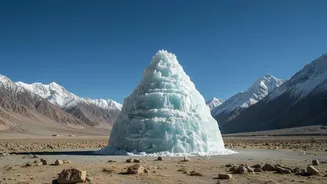
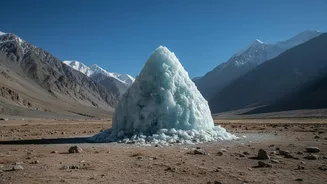
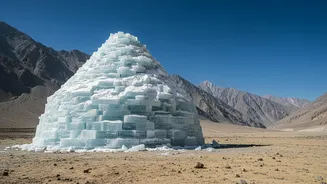
The solution came from an observation by engineer and innovator Sonam Wangchuk. He noticed that ice in shaded areas, like under a bridge, could survive well into the late spring even as temperatures rose. This sparked an idea: what if you could 'store' the plentiful winter water in a form that would last until it was needed? The result was the ice stupa, an artificial glacier shaped like a giant cone. The name is a nod to the traditional Buddhist monuments that dot the Ladakhi landscape. The concept is simple yet brilliant: collect water that would otherwise be wasted during the freezing winter and consolidate it into a massive ice structure that melts slowly, releasing water just in time for the spring planting season.
The Physics of an Artificial Glacier
The construction of an ice stupa is a masterclass in applied physics, requiring no electricity or heavy machinery. First, water is piped from a glacial stream at a higher altitude. Gravity does all the work, creating natural pressure as the water flows downwards. This pressurised water is then sprayed out of a vertical pipe into the frigid winter air, which can drop well below freezing. As the fine droplets fall, they freeze instantly, gradually forming a colossal cone of ice around the pipe’s base. The conical shape is intentional and crucial. Basic geometry dictates that a cone has a minimal surface area for its volume compared to a flat sheet of ice. This shape minimizes exposure to direct sunlight, ensuring the stupa melts much more slowly than a horizontal field of ice would.
Rooted in Local Wisdom
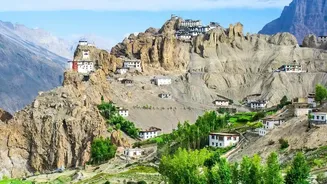
While the physics are modern, the underlying principles are deeply connected to centuries of local knowledge. For generations, Ladakhis have developed sophisticated techniques for managing scarce water resources. Traditional water harvesting systems like 'zings'—small reservoirs that collect glacial melt—and intricate networks of channels called 'yuras' have been the backbone of agriculture in the region. The ice stupa project builds upon this legacy. It is a modern re-invention of the age-old practice of glacier grafting, but adapted for lower altitudes and greater efficiency. This connection to tradition ensures community buy-in and participation, turning the construction of stupas into a collaborative effort that empowers local villagers.
A Symbol of Hope and Resilience
Since the first prototype was built in 2013, the ice stupa project has become a resounding success. That initial 6-metre structure stored 150,000 litres of water. Subsequent versions have grown much larger, some holding millions of litres of water, enough to irrigate thousands of newly planted trees and secure crops for entire villages. The initiative, led by Wangchuk's NGO, the Students' Educational and Cultural Movement of Ladakh (SECMOL), has inspired the construction of dozens of ice stupas across Ladakh. The project has gained international recognition and is even being replicated in other mountain regions facing similar challenges. More than just a clever engineering solution, the ice stupas are powerful symbols of community-led climate adaptation, demonstrating how local ingenuity can provide a sustainable path forward in a rapidly changing world.