



The Power of Less
Minimalism isn't about owning nothing; it's about owning what matters. In a workspace, this philosophy translates to a decluttered environment that promotes clarity and focus. The constant visual noise of a messy desk can subtly drain your mental energy.
By stripping away the non-essentials, you create physical and mental space for productivity. But a truly minimal space isn't sterile—it's intentional. A single, carefully chosen element, like a living plant, can transform a desk from stark to serene. It serves as a focal point, a tiny connection to the natural world that can reduce stress and boost creativity, proving that sometimes, less truly is more.
Why the Money Plant?
The Money Plant, or Epipremnum aureum (Pothos), is the perfect candidate for this project. In India, it's more than just a houseplant; it's a symbol of good luck and prosperity, making it a wonderful addition to a professional space. Beyond its cultural significance, the Money Plant is famously resilient. It thrives in a variety of light conditions, from bright, indirect sunlight to lower-lit office corners, and it's forgiving if you occasionally forget to water it. Its air-purifying qualities are an added bonus, helping to clean the very air you breathe while you work. Best of all, it propagates with astonishing ease, making it the ideal plant for beginners and seasoned gardeners alike.
The Simple Art of Propagation
Propagating a Money Plant is a rewarding and surprisingly simple process. You don't need a garden, special tools, or a green thumb—just a healthy parent plant and a pair of clean scissors. First, locate a healthy vine on an existing Money Plant. Look for a stem that is at least 6-8 inches long with several leaves. Identify the nodes—small brown bumps on the stem where new leaves and roots emerge. Make a clean cut with your scissors about half an inch below a node. Once you have your cutting, gently pinch off the lowest leaf or two, ensuring that at least one node is clear to be submerged in water. This is where your new roots will sprout from.
Choosing Your Vessel: The Amber Vial
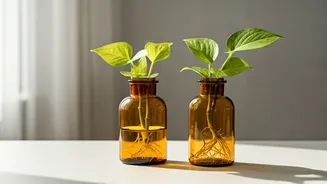
The container you choose is as important as the plant itself in achieving the minimalist aesthetic. Small, amber-coloured glass vials or bottles are an excellent choice. The dark, warm tone of the amber glass provides a beautiful contrast to the vibrant green of the Money Plant leaf. Aesthetically, it adds a touch of vintage, scientific elegance to your desk. Practically, the amber colour helps protect the developing roots from direct, harsh sunlight, which can sometimes encourage algae growth in clear glass. If you can't find amber vials, small apothecary jars, clean spice bottles, or even single-stem glass vases will work beautifully. The key is to choose something small and transparent enough to watch the roots grow, but stylish enough to complement your minimal setup.
Patience, Water, and Light
Place your cutting into the amber vial and fill it with enough room-temperature water to cover the submerged node. Tap water is usually fine, but if your water is heavily chlorinated, let it sit out for 24 hours before use. Place your vial in a spot that receives bright, indirect light. A spot near a window but not in the direct sunbeam is perfect. Now, the easy part: wait. Within a week or two, you should start to see fine, white roots emerging from the node. To keep the water fresh and oxygenated, change it every 5-7 days. Watching the roots develop is a quiet, meditative process—a daily reminder of slow, steady growth.
Styling Your Minimalist Corner
Once your cutting has established a small root system, it’s a permanent fixture of your workspace. The beauty of this element is its simplicity. It doesn’t demand much space. Place it in a corner of your desk to soften the hard lines of your monitor or laptop. Position it on a small stack of books to add a bit of height and dimension. Or, line up two or three vials along a floating shelf above your desk for a clean, rhythmic pattern. The single vine in a simple bottle is a statement. It says you value beauty, nature, and intention in your daily environment, creating a workspace that not only functions well but also feels good to be in.