





The Trouble with Wheels
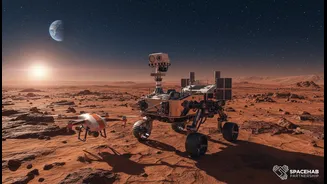
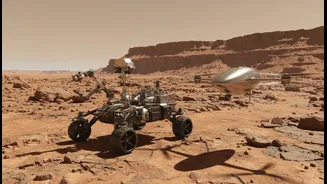
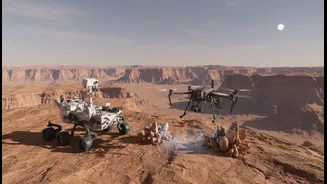
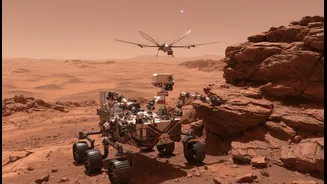
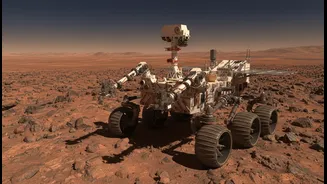
Planetary rovers like Curiosity and Perseverance are marvels of engineering, but they share a fundamental vulnerability with any car: they can get stuck. Sandy dunes, steep crater walls, and fields of sharp rocks present major obstacles that can slow
down or even end a mission. While the Ingenuity helicopter proved the value of flight on Mars, both wheels and rotors are limited in the complex, unpredictable landscapes found on other worlds. These 'difficult terrains' are often the most scientifically interesting, containing clues to a planet's geological past or potential for life. To get to them, NASA realized it needed to fundamentally rethink robotic mobility, moving beyond the reliable but restrictive wheel.
Enter STRIDE: A Leap Forward
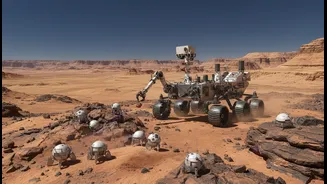
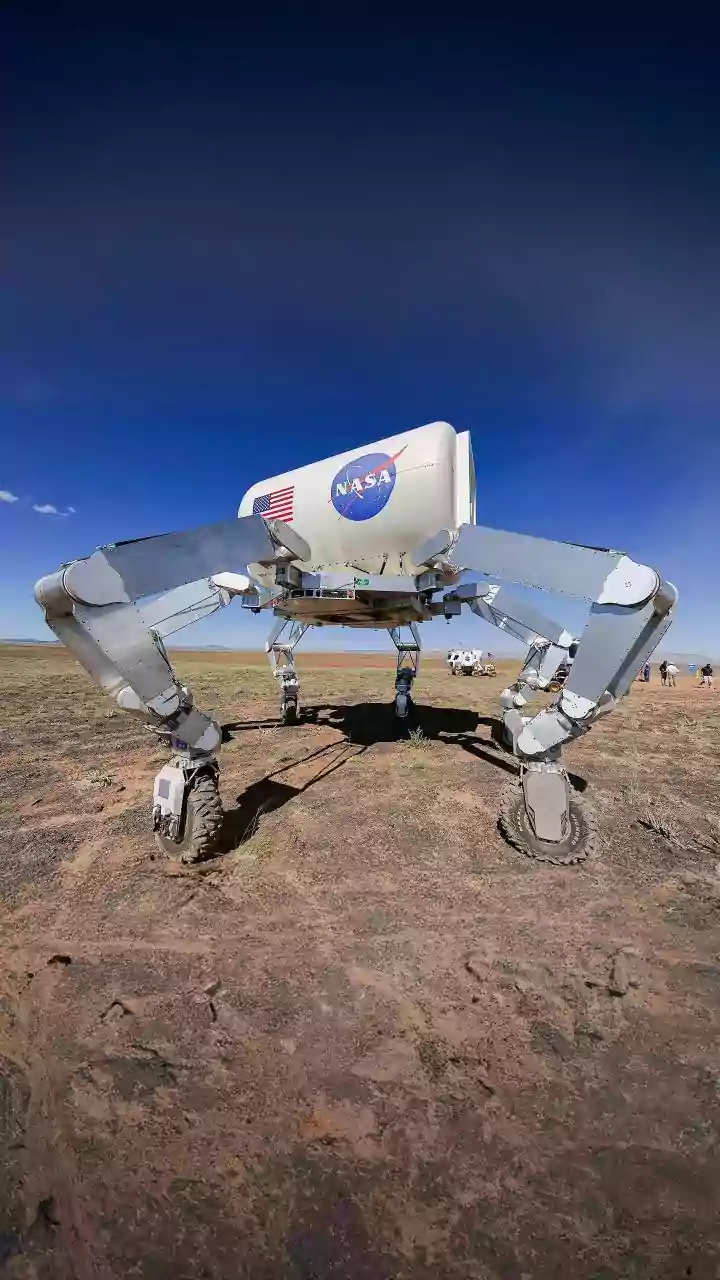
STRIDE, which stands for Science Transport and Robotic Innovation for Deployment and Exploration, is NASA's answer to this challenge. It is not a single robot, but a forward-thinking initiative designed to foster a new generation of robotic explorers. The core idea is to partner with and fund private US industry, from established aerospace companies to innovative startups, to develop advanced mobility systems. Announced in early 2026, the program recently awarded contracts to seven companies to develop concepts for both surface and aerial vehicles capable of navigating treacherous Martian environments. The goal is to create platforms that can carry scientific payloads to places previously considered unreachable, dramatically expanding the scope of future missions.
Learning to Walk, Climb, and Slither
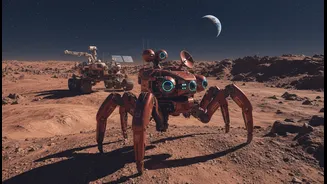
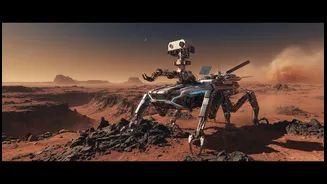
The most revolutionary aspect of the technologies being explored is a shift towards legged, or 'bio-inspired', locomotion. Instead of just rolling over a landscape, future robots might walk on four legs like a mountain goat, slither like a snake, or even use a combination of movements. One such concept is the Exobiology Extant Life Surveyor (EELS), a snake-like robot designed to explore icy vents on moons like Enceladus. Its segmented body and rotating screw-like 'skin' would allow it to crawl across surfaces, descend into narrow shafts, and even move through liquid. Other projects, like the LASSIE-M, focus on quadrupedal 'dog-like' robots that can feel the terrain through their legs, automatically adjusting their gait for sand, ice, or rock. This adaptability is key to navigating the unknown.
More Than Just Mobility
These new designs offer more than just a way to get from point A to B. They transform the robot itself into a scientific instrument. A legged robot can measure the softness and composition of the ground with every step it takes, providing a continuous stream of geotechnical data without needing a separate tool. This allows scientists to build a much richer understanding of the environment. Furthermore, concepts like EELS are designed for full autonomy, using onboard AI to make decisions in real-time. This is crucial for exploring distant worlds where the communication delay with Earth can be many minutes, making direct remote control impossible in critical situations. This AI-driven autonomy allows the robot to react instantly to hazards and opportunities.
From Mars and Moons to Mines and Mountains
While the primary goal of STRIDE is space exploration, the technologies it fosters have massive implications back on Earth. Agile, autonomous robots that can navigate complex and dangerous environments could revolutionize numerous industries in India and across the globe. Imagine snake-like robots inspecting underground pipelines or navigating collapsed buildings in disaster zones to find survivors. Quadrupedal robots could deliver supplies in rugged, mountainous terrain inaccessible to vehicles, assist in dangerous mining operations, or perform agricultural tasks with unprecedented precision. By funding the development of these systems for Mars, NASA is accelerating innovation that will almost certainly find its way into our daily lives, making work safer and solving some of Earth's most difficult logistical challenges.