






The Chemical-Free Conundrum
The boom in urban agriculture—from rooftop gardens to high-tech vertical farms—is driven by a desire for fresher food with a smaller environmental footprint. But growing food in the city comes with a unique set of problems. Chief among them is pest control.
In a dense urban environment, blanketing crops with traditional chemical pesticides is often a non-starter. Concerns about air quality, water runoff, and direct human exposure make chemical solutions unattractive and often heavily regulated. Consumers drawn to local produce are also typically seeking food that is as clean and natural as possible. This leaves urban farmers in a bind: how do you protect your high-value, densely packed crops from insects and other pests without resorting to the very chemicals the urban farming movement seeks to avoid?
Sound as a Silent Shield
Enter bioacoustics, a field of science that studies how living things produce and react to sound. Researchers and a growing number of agri-tech companies are developing systems that use sound waves, often at frequencies above human hearing (ultrasonic), as a form of pest management. Instead of killing pests with toxins, this technology aims to create an environment that is so unpleasant or confusing for them that they simply leave the area or cannot function properly. It’s a concept that’s been around for a while in consumer-grade repellent devices, but it's now being refined with advanced technology and artificial intelligence for large-scale agricultural use. The goal is to create a targeted, invisible shield that protects plants without harming them, the environment, or the people who will eventually eat them.
How Frequencies Disrupt Pests
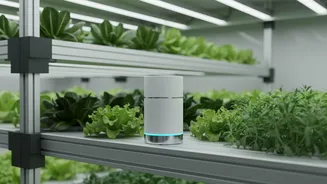
The technology works by emitting specific sound frequencies that interfere with the natural behavior of pests. These devices, called ultrasonic transducers, convert electrical signals into high-frequency sound waves. For many insects and rodents, these frequencies are intensely irritating, effectively creating an acoustic barrier that they are unwilling to cross. It’s like a constant, unbearable alarm that only they can hear. But the approach can be more sophisticated than just annoyance. Some systems are designed to mimic the sounds of predators, triggering a flight response. Others can disrupt communication, such as mating calls, or interfere with an insect's ability to navigate and find food. By identifying the specific frequencies that affect target pests, these systems can be fine-tuned to protect a crop from a specific threat while leaving beneficial insects, like pollinators, unharmed.
A Perfect Fit for Indoor Farming
While acoustic pest control has applications in open fields, it's particularly well-suited for the controlled environments of urban and vertical farms. In an enclosed space, sound waves can be contained and reflected, filling the entire area and leaving pests with nowhere to hide. This overcomes one of the technology's limitations in open fields, where sound waves dissipate over distance. Furthermore, the background noise in a controlled environment is minimal and predictable, allowing the system to operate with greater precision and less interference. For high-tech vertical farms, which are often highly automated and data-driven, integrating an acoustic defense system is a natural fit. It aligns perfectly with the sector's emphasis on precision, sustainability, and producing a pure, pesticide-free product for discerning urban markets.
The Path to Widespread Use
Acoustic crop protection is still an emerging field, and it faces hurdles on its way to mainstream adoption. One of the main challenges is that its effectiveness can vary significantly depending on the pest species, the specific frequency used, and environmental factors. Some critics note that pests can, over time, become habituated to a constant sound, requiring systems that can vary their frequencies to remain effective. The initial investment in the equipment can also be higher than for traditional chemical sprays. However, a growing number of companies are entering the market, and ongoing research is focused on creating more sophisticated, AI-driven systems that can automatically identify pests by the sounds they make and deploy a targeted acoustic response. As the technology matures and costs decrease, soundwave-powered shields could become a standard, sustainable tool for the future of farming.