






The Cosmic Speed Limit
It all comes down to one fundamental rule of the universe: light, while incredibly fast, is not instantaneous. It travels at a blistering pace of nearly 300,000 kilometres per second. That’s fast enough to circle the Earth more than seven times in a single
second. But when you start talking about the sheer, mind-boggling scale of the cosmos, even that speed seems almost pedestrian. To measure these vast distances, astronomers use the 'light-year', which is the distance light travels in one year. It's not a unit of time, but a unit of distance—a very, very big one, equalling about 9.5 trillion kilometres. So, when we say a star is 10 light-years away, it means the light we see from it tonight began its journey 10 years ago. In effect, we are seeing that star as it existed a decade in the past.
Our Nearest Celestial Neighbours
Let’s start close to home. The closest star system to us is Alpha Centauri, located about 4.3 light-years away. If you were looking at it tonight, the light entering your eyes would have left the star around the same time you might have been preparing for your final school exams or starting a new job. Another familiar sight in the Indian night sky, Sirius, the brightest star we can see, is about 8.6 light-years away. The light from Sirius is a snapshot from nearly a decade ago. These stars are our immediate cosmic neighbours, and their light is relatively fresh, carrying news from the recent past.
A Glimpse of History
As we look farther out, the time-travel effect becomes much more profound. Take Polaris, the North Star. It’s approximately 430 light-years away. This means the starlight we see from Polaris tonight started its journey around the year 1594. While that light was travelling through space, the Mughal Empire was flourishing in India under Emperor Akbar, and Shakespeare was writing plays in England. The star we see is a relic from a different historical era. Every twinkle is a photon that left its home star long before the first steam engine was ever conceived. The night sky isn't just a canvas of stars; it's a museum of cosmic history, with exhibits dating back centuries.
When Stars Might Already Be Gone
The story gets even more dramatic with stars like Betelgeuse, the bright reddish star in the constellation Orion. It is located roughly 640 light-years away. Betelgeuse is a massive star nearing the end of its life, and astronomers believe it could explode in a spectacular supernova at any time. The twist? It might have already happened. If Betelgeuse exploded in the year 1700, the light from that cataclysmic event would still be on its way, and we wouldn’t know about it for another few decades. We are watching a star that could, for all we know, already be a ghost. This lag between an event and our observation of it is a fundamental aspect of astronomy.
Looking Beyond Our Galaxy
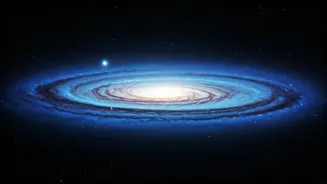
The truly mind-bending time travel begins when we look beyond our own Milky Way galaxy. The Andromeda Galaxy is the closest major galaxy to ours, and it’s visible to the naked eye as a faint, fuzzy patch on a very dark night. It is 2.5 million light-years away. The light you see from Andromeda tonight left its source 2.5 million years ago. At that time, modern humans did not exist. Our early ancestors, the first hominids, were just beginning to walk the Earth in Africa. When you gaze at Andromeda, you are looking at light that is older than our entire species. It is the most ancient history you can witness with your own eyes.