



The Science of Synchronicity
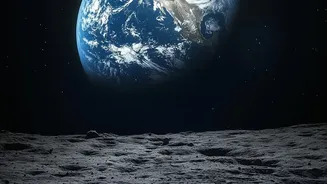
The phenomenon of the Moon showing the same face to Earth is called 'synchronous rotation' or 'tidal locking'. This simply means that the Moon rotates on its axis at the exact same rate that it revolves around the Earth—roughly once every 27.3 days. If
the Moon didn't rotate at all, we would see its entire surface as it orbited our planet. Conversely, if it rotated faster or slower, its face would appear to gradually turn. Instead, the perfect synchronisation of its spin and orbit keeps one hemisphere perpetually turned in our direction. This isn't a freak coincidence but a common outcome for moons and planets throughout the solar system.
A Gravitational Tug-of-War
So, how did this happen? The answer lies in gravity and tides. Billions of years ago, when the Moon was newly formed and likely a molten body, it spun much faster than it does today. Earth’s powerful gravity pulled on the Moon, but not uniformly. The pull was strongest on the side of the Moon closest to Earth and weakest on the far side. This difference created a slight bulge in the Moon, stretching it into a subtle oval shape. As the fast-spinning Moon tried to rotate, Earth's gravity tugged on these tidal bulges, creating a braking force, or torque. This constant tug-of-war generated friction and heat, dissipating the Moon's rotational energy and gradually slowing its spin over millions of years.
Finding a Stable Balance
This gravitational braking continued until the Moon's rotation slowed down enough to match the speed of its orbit around Earth. At that point, the gravitational tugging stopped having a net braking effect. The Moon’s bulge settled into a stable alignment, always pointing towards Earth, and it became 'tidally locked'. This process is a natural consequence of two bodies orbiting each other closely. Most of the large moons in our solar system, such as Jupiter's four Galilean moons, are also tidally locked with their parent planet.
The Myth of the 'Dark Side'
The fact that we only see one side of the Moon has led to the popular term 'the dark side of the Moon'. However, this is a misnomer. The side we don't see is more accurately called the 'far side'. It's not permanently dark; in fact, it receives just as much sunlight as the near side does. The far side experiences its own two-week-long day and two-week-long night, just like the side facing us. The term 'dark' historically meant 'unknown' or 'unseen', because humanity had never laid eyes on the far side until the Soviet Luna 3 probe photographed it in 1959.
A Slight Wobble in the View
While the Moon is tidally locked, we can actually see slightly more than just 50 percent of its surface over time. Due to a series of wobbles known as 'lunar libration', we can peek around the edges a bit, revealing up to 59 percent of the Moon's total surface. This wobble occurs for two main reasons. First, the Moon’s orbit is an ellipse, not a perfect circle, so its orbital speed varies. Its rotation, however, is constant. This mismatch causes a side-to-side wobble. Second, the Moon's axis is slightly tilted, allowing us to see a little more of its northern and southern polar regions at different times in its orbit. This gives astronomers on Earth a slightly more complete picture of our celestial neighbour.