






The Monsoon Energy Dilemma
India has made incredible strides in solar energy, becoming a world leader in renewable power. Yet, the nation's ambitious clean energy goals face a recurring, seasonal hurdle: the monsoon. For three to four months, vast swathes of the country are covered
in thick clouds, drastically reducing the output of conventional solar panels. While panels can still generate some power from diffuse light, their efficiency plummets on overcast and rainy days—sometimes to as low as 10-25% of their peak capacity. This intermittency is a major issue for grid stability, forcing a greater reliance on fossil fuels precisely when the country is working to phase them out. The monsoon, a cornerstone of India's climate and economy, paradoxically becomes a period of energy anxiety.
An All-Weather Breakthrough
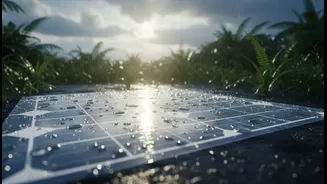
Imagine a solar panel that doesn't just tolerate the rain but uses it to generate power. This is the promise of two key technological breakthroughs. The first involves perovskite solar cells (PSCs). These are synthetic crystalline materials that are not only cheaper to produce than traditional silicon but are also exceptionally good at generating power in low-light conditions. Researchers have developed PSCs with remarkable indoor efficiency, signaling their potential for cloudy days. The second breakthrough is even more revolutionary: hybrid solar cells. These devices combine a standard photovoltaic layer with a triboelectric nanogenerator (TENG). This TENG layer can harvest the kinetic energy of falling raindrops, turning a rainy day from a problem into a power source.
How Do They Generate Power From Rain?
The science behind generating power from raindrops is based on the triboelectric effect—the same phenomenon that creates static electricity. The hybrid panels are coated with a transparent, water-resistant film. When raindrops hit and slide down this specially-coated surface, the friction creates a small electrical charge. The TENG layer captures this charge and converts it into usable electricity. While a single drop only generates a tiny amount of power, the collective impact of a downpour can be significant. Recent lab tests have shown that the impact of one raindrop can generate an open-circuit voltage of over 100 volts, enough to power small electronics like LEDs. Because the top layers are transparent, the underlying solar cell continues to generate power from any available sunlight simultaneously.
A Game-Changer for India's Energy Grid
The implications for India are enormous. All-weather solar panels could fundamentally change the nation's energy landscape. During the monsoon, these panels would supplement reduced solar generation with rain-powered electricity, creating a more stable and reliable power supply year-round. This would reduce the need for expensive battery storage solutions and backup power from polluting sources. For a country aiming to achieve 500 GW of non-fossil fuel capacity by 2030, this technology offers a path to overcoming the key challenge of weather dependency. Furthermore, in regions prone to cyclones and heavy rains, such technology would make the energy infrastructure more resilient, ensuring a more consistent power supply for critical services and remote communities.
From Lab to Rooftop: The Road Ahead
While incredibly promising, this technology is not yet ready for mass-market deployment. Much of the research is at the proof-of-concept or laboratory stage. One of the biggest challenges for perovskite cells has been durability, as they can degrade when exposed to moisture. However, new protective coatings being developed for hybrid cells also help solve this problem, making them more robust. Researchers are now focused on improving the efficiency of the TENG component, reducing manufacturing costs, and scaling up production. While you may not be able to install a rain-harvesting solar panel on your roof tomorrow, the rapid pace of innovation suggests that a future of weather-independent clean energy is closer than we think.