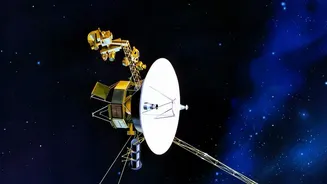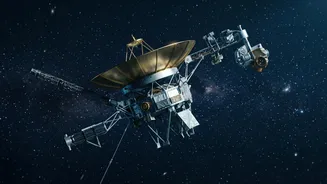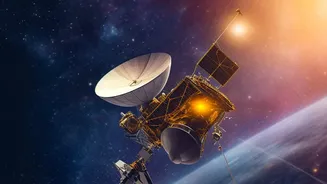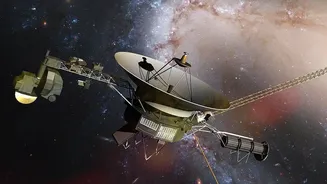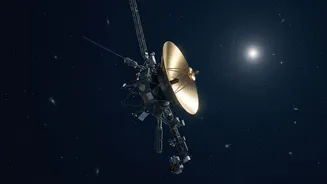

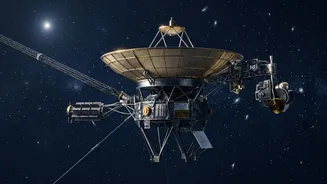
Launched when 1970s technology was cutting-edge, NASA's Voyager 1 is about to make history again. The intrepid probe is set to become the first human object to reach a distance of one light-day from Earth, a milestone of cosmic proportions.
A Journey of Unfathomable Distance
On November
18, 2026, Voyager 1 will be approximately 25.9 billion kilometers away from our planet. That number is so large it's almost meaningless. A light-day, however, offers a more tangible, if mind-bending, perspective. It is the distance light travels in a full 24 hours. Consider that light from the Moon reaches us in just over a second, and from the Sun in about eight minutes. When Voyager 1 crosses this threshold, a radio signal sent from Earth will take an entire day to reach it, and another full day for its response to return. A simple 'hello' and its reply will involve a two-day wait, a profound demonstration of the sheer scale of space.
The Little Probe That Could
Voyager 1’s longevity is as remarkable as its distance. Launched on September 5, 1977, its original mission was a 'Grand Tour' of the outer planets. It flew past Jupiter in 1979 and Saturn in 1980, revolutionizing our understanding of the gas giants. Its cameras revealed the first active volcanoes beyond Earth on Jupiter's moon Io, discovered new rings around both planets, and studied Saturn's mysterious moon Titan. After its primary mission ended in 1980, it just kept going. In 1990, it turned its camera back one last time to capture the iconic 'Pale Blue Dot' image of Earth, a humbling portrait of our place in the cosmos.
A Faint Voice From the Void
Today, Voyager 1 is in interstellar space, having exited the protective bubble of solar wind known as the heliosphere in 2012. It is humanity's only active messenger in the vast expanse between the stars. Despite its 1970s-era technology and dwindling power supply, it continues to communicate with NASA's Deep Space Network. Engineers have become incredibly resourceful, recently performing complex maneuvers to conserve energy and keep its instruments alive. Even after a brief, concerning communication pause in October 2026, the probe remains operational. Two of its instruments, a magnetometer and a plasma wave detector, still send back valuable data about the interstellar medium, an environment never before measured directly.
Humanity's Message in a Bottle
Beyond its scientific purpose, Voyager 1 carries a symbolic message. Bolted to its side is the Golden Record, a 12-inch, gold-plated copper disk containing sounds and images selected to portray the diversity of life and culture on Earth. It includes greetings in 55 languages, music from different eras and cultures, and natural sounds of the planet. It is a time capsule, a greeting card to any potential extraterrestrial civilization that might one day encounter the silent probe. It represents a hope that the story of humanity might outlive us, carried on a vessel built half a century ago. Its journey transforms it from a mere machine into an emissary of our entire species.
The Long Twilight Ahead
This one-light-day milestone may be one of Voyager 1's last celebrated achievements while it can still phone home. Its nuclear power source, which produced 470 watts at launch, decays steadily, losing about four watts of power each year. NASA engineers expect to keep at least one scientific instrument running until around 2030, but by 2036, its signal may become too faint to detect. But its journey will not end. The spacecraft will continue coasting through the Milky Way for eons, a silent testament to human curiosity. In about 40,000 years, it will drift past a star named Gliese 445, long after its creators are gone.