

A Breakthrough in Solar Observation
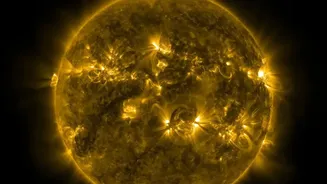
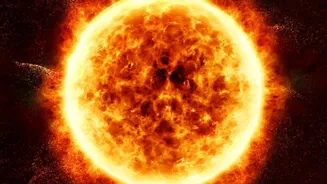
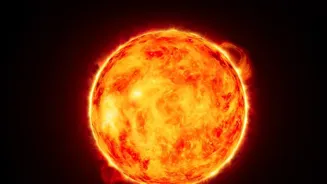
Using the world's largest solar telescope, the Daniel K. Inouye Solar Telescope in Hawaii, scientists have captured the most detailed images ever of the Sun's visible surface, known as the photosphere. These unprecedented images revealed tiny, swirling
vortices of plasma, some as small as 20 kilometres wide. These whirlpools are the result of a phenomenon known as Kelvin-Helmholtz instability, which occurs when two fluids or plasmas flowing at different speeds move past each other. While this effect is common in nature—seen in ocean waves and clouds on Earth—observing it at such a small scale on the Sun marks a significant leap forward in solar physics.
Solving the Coronal Heating Puzzle
One of the most enduring mysteries in astrophysics is the coronal heating problem. The Sun’s outer atmosphere, the corona, sizzles at temperatures of millions of degrees Celsius, while its surface is a comparatively cooler 5,500 degrees. Scientists have long theorised that some mechanism must be pumping energy from the surface into the corona. These newly discovered vortices may be a key part of that mechanism. The swirling motions can twist and tangle the Sun's magnetic field lines, building up huge amounts of energy. This process is believed to transfer energy from the churning plasma on the surface upwards into the incredibly hot outer atmosphere, offering a potential explanation for its extreme temperatures.
The Link to Solar Flares and Space Weather
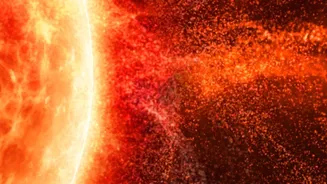
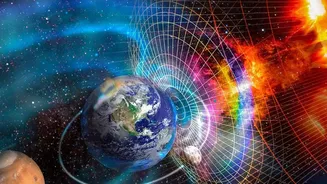
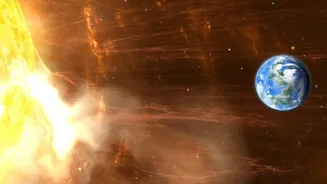
The same twisting of magnetic field lines that may heat the corona is also thought to be the engine behind explosive solar events. When these tangled magnetic fields suddenly snap and reconnect, they can release enormous bursts of energy in the form of solar flares and coronal mass ejections (CMEs). These events hurl streams of charged particles into space, creating what is known as space weather. When directed at Earth, severe space weather can disrupt satellites, damage power grids, and endanger astronauts. By studying how these tiny vortices build and store magnetic energy, scientists hope to improve their ability to forecast these powerful solar storms and mitigate their impact on our technology-dependent world.
Understanding the Solar Wind
The Sun constantly releases a stream of charged particles called the solar wind, which flows throughout the entire solar system. Another solar mystery is why this wind accelerates and stays hotter than expected as it travels away from the Sun. Plasma waves, particularly a type known as Alfvén waves, are believed to play a crucial role in this process by transferring energy to the solar wind particles. The discovery of the small-scale vortices provides direct evidence of the kind of plasma turbulence that can generate these waves. Data from missions like the Parker Solar Probe and the European Space Agency's Solar Orbiter has provided strong indications that these waves are indeed heating and accelerating the solar wind, and the new observations help complete the picture.