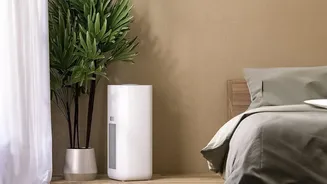





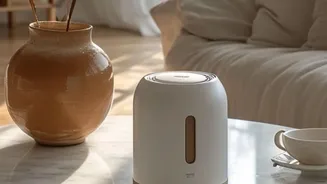


The desire for fresh, clean air inside our homes is universal. Two popular solutions dominate the conversation: leafy houseplants and modern air purifiers. But which one truly delivers on the promise of a healthier indoor environment?
The Houseplant Myth
The idea that houseplants
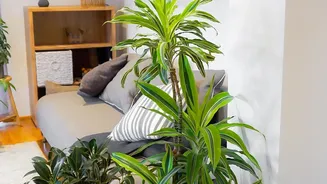
can purify indoor air is a persistent one, largely stemming from a 1989 NASA study. This research showed that in a small, sealed chamber, certain plants could remove volatile organic compounds (VOCs) like benzene and formaldehyde. However, a home is not a sealed lab chamber. More recent studies have concluded that you would need an impractically large number of plants—anywhere from 10 to 1,000 per square metre—to make a significant dent in your home's air quality. A typical room would need to become an impassable jungle of hundreds of plants just to match the natural air exchange rate, let alone the work of a purifier. While plants are fantastic for aesthetics, boosting humidity, and improving mental well-being, they are not effective air cleaners in a real-world home setting.
How Air Purifiers Actually Work
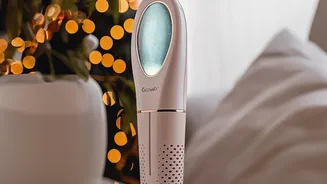
Unlike the passive approach of plants, air purifiers are engineered specifically to clean the air actively and efficiently. Most high-quality purifiers use a multi-stage filtration system. The workhorse is the HEPA (High-Efficiency Particulate Air) filter, a dense mesh of fibres that physically traps airborne particles. This includes common irritants like dust, pollen, pet dander, mould spores, and the harmful PM2.5 particles found in smoke and pollution. The second key component is an activated carbon filter. This material is highly porous and works through adsorption, trapping gas molecules, VOCs from paint and furniture, and unpleasant odours that HEPA filters cannot catch. By combining these two technologies, a good air purifier can address the full spectrum of common indoor pollutants.
The Verdict: Technology Over Nature
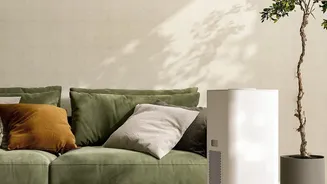
When it comes to meaningfully improving indoor air quality, there is no contest: air purifiers are vastly more effective than houseplants. A single air purifier can circulate and clean the air in a room multiple times per hour, removing up to 99.97% of certain airborne particles. Plants, on the other hand, have a negligible impact on pollutant levels in a typical home. The best way to think about it is this: buy houseplants to beautify your space and boost your mood, but buy an air purifier to actually clean your air. They serve two entirely different, though complementary, purposes.
The Key Spec: Understanding CADR
Once you've decided on a purifier, the most important metric to understand is its CADR, or Clean Air Delivery Rate. Developed by the Association of Home Appliance Manufacturers (AHAM), CADR measures the volume of filtered air a purifier can deliver in a specific amount of time, usually in cubic feet per minute (CFM) or cubic metres per hour (m³/h). A higher CADR means the unit cleans the air faster. You will often see three separate CADR numbers for smoke, dust, and pollen, which represent small, medium, and large particles, respectively. For general air quality concerns, the smoke rating is often the most useful one to consider as it represents the smallest, hardest-to-trap particles.
Matching a Purifier to Your Room
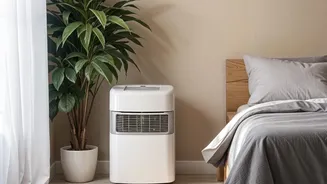
Choosing a purifier that is too small for your room is a common mistake that renders it ineffective. To pick the right size, you need to match the unit's CADR to your room's square footage. A widely accepted guideline is the 'two/thirds rule': the purifier's smoke CADR number should be at least two/thirds of your room's area in square feet. For example,' for a '15-'foot by '12-'foot bedroom ('180 sq ft'), you would need a purifier with a smoke CADR of at least '120 ('180 x '2/3 = '120). For those with higher ceilings ('over '8-'9 feet), allergies,' or concerns about heavy pollution,' it is wise to size up and choose an even more powerful unit. Remember that portable purifiers are designed for single,' enclosed spaces;' an open-'plan living area may require a larger unit or multiple smaller ones to achieve effective coverage.
Other Factors to Consider
While CADR is the most critical factor for performance,' a few other features are worth considering.' Check the noise levels,' especially for a unit destined for a bedroom or office.' Also,' investigate the cost and availability of replacement filters,' as these are an ongoing expense necessary to maintain the purifier's effectiveness.' Many modern units come with smart features like an auto mode,' which uses an onboard air quality sensor to adjust the fan speed automatically.' This can be a convenient and energy-'efficient feature.' Finally,' consider the energy consumption to understand the long-'term running costs.