


A New Kind of Vision
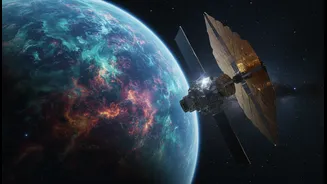
The James Webb Space Telescope is not just a more powerful successor to Hubble; it is a fundamentally different kind of observatory. Its massive, golden mirror is designed to capture infrared light, which is invisible to the human eye. This capability
is a game-changer for studying exoplanets—planets orbiting other stars. Earth's own atmosphere blocks out much of the infrared spectrum, making a space-based observatory like Webb essential. The telescope's primary technique is called transit spectroscopy. As an exoplanet passes in front of its host star, a tiny fraction of the starlight filters through the planet’s atmosphere. Webb’s sensitive instruments can analyze that light, looking for the unique chemical fingerprints left behind by different gases. The wavelengths of light that are absorbed reveal which molecules are present, giving scientists a detailed atmospheric menu from light-years away.
From Discovery to Diagnosis
Previous missions, like the incredibly successful Kepler Space Telescope, were designed to find exoplanets by detecting the faint dimming of a star as a planet transits. They proved that planets are incredibly common in our galaxy. But finding them was only the first step. Webb ushers in the era of exoplanet characterization. Instead of just knowing a planet’s size and orbit, we can now begin to diagnose its climate, composition, and potential for hosting life. This leap is akin to going from seeing blurry dots in the distance to being able to read the ingredients on their labels. Webb's spectrographs can identify a range of molecules crucial for understanding a planet's nature, including water vapor, methane, carbon dioxide, and even signs of active chemistry like sulfur dioxide. This allows astronomers to build a more complete picture of the diversity of worlds that exist beyond our solar system.
A Catalogue of Alien Worlds
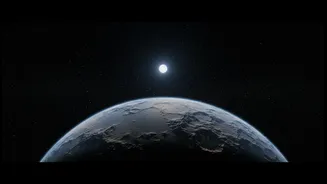
The early results from Webb have been nothing short of spectacular, revealing a stunning variety of planetary environments. For instance, observations of K2-18b, a world larger than Earth orbiting in its star’s habitable zone, revealed the presence of methane and carbon dioxide. This finding is consistent with theories about so-called 'Hycean' worlds—hypothetical planets covered in deep oceans with hydrogen-rich atmospheres. On the other end of the spectrum, Webb has studied rocky, Earth-sized planets in the famous TRAPPIST-1 system. It found that the innermost planet appears to be a bare rock with no detectable atmosphere, likely scoured away by the intense radiation from its nearby star. This, too, is a crucial discovery, helping scientists understand the dividing line between habitable and uninhabitable worlds. Each observation, whether of a gassy giant or a barren rock, provides a vital data point in our growing catalogue of alien worlds.
The Search for Signs of Life
Perhaps the most profound goal of Webb's mission is the search for biosignatures—gases in an atmosphere that could indicate the presence of life. This is an incredibly complex task. While gases like oxygen and methane can be produced by life, they can also arise from purely geological or chemical processes. Webb has provided some tantalizing hints, including a weak signal of dimethyl sulfide (DMS) in K2-18b's atmosphere. On Earth, DMS is overwhelmingly produced by microbial life, like marine phytoplankton. However, scientists are extremely cautious. The detection is not yet definitive and requires more observation time to confirm. The future value of Webb lies not in a single, knockout discovery, but in its ability to analyze the full context of an atmosphere. The simultaneous presence or absence of multiple gases can help astronomers distinguish a world teeming with life from one that merely mimics it.
A Glimpse into Our Own Future
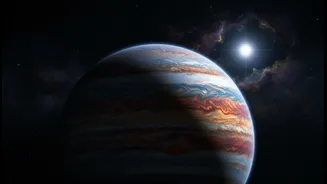
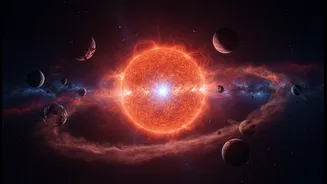
Webb’s studies are not just about distant, alien worlds; they also offer a stunning preview of our own solar system's fate. In a recent study from July 2026, astronomers used the telescope to observe WD 1856 b, a Jupiter-sized planet orbiting a white dwarf—the dead, collapsed core of a star that was once like our sun. Billions of years from now, our sun will swell into a red giant, likely consuming the inner planets, before shrinking into a white dwarf. The fact that this planet survived its star's death and now orbits it closely provides a fascinating look into what might happen to Jupiter and Saturn. By studying the planet's temperature and atmosphere, Webb is essentially acting as a time machine, peering billions of years into our solar system's post-apocalyptic future.