
The Legend of the Seven Pagodas
The story, passed down through generations of fishermen and recorded by early European travellers, speaks of seven grand temples that once graced the shoreline. Only one, the iconic Shore Temple, remains standing today, a silent testament to a supposedly
grander, submerged complex. This enduring tale, known as the legend of the 'Seven Pagodas', describes a city so beautiful that the gods grew envious and sent a great flood to consume it, leaving just a single spire as a reminder of its former glory. For a long time, historians dismissed these accounts as mere folklore. However, anecdotal evidence persisted, with local fishermen claiming to have glimpsed glittering ruins beneath the sea on calm days. These whispers from the deep kept the legend alive, waiting for technology to catch up with mythology.
Peering Through the Depths
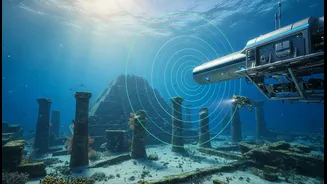
The key to unlocking this centuries-old mystery lies in modern science. Teams from India's National Institute of Oceanography (NIO) and the Archaeological Survey of India (ASI) have been deploying sophisticated tools to map the seabed off the Mahabalipuram coast. A crucial piece of this technological puzzle is side-scan sonar. This equipment is towed behind a boat and sends out acoustic pulses, which fan out to scan the seafloor. The echoes that return are converted into detailed images, creating a 'sound map' of what lies below. This method allows researchers to 'see' through the water and layers of sediment without disturbing the site, revealing the shapes of objects that could be man-made. In recent years, they have also started using Remotely Operated Vehicles (ROVs) to get high-resolution video of the submerged remains, enhancing the precision and safety of underwater research.
What the Sonar Revealed
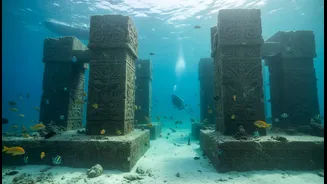
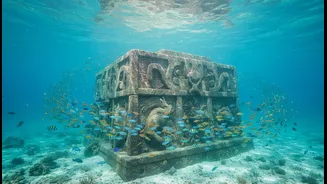
The sonar surveys and subsequent dives have yielded remarkable findings. Researchers have identified what appear to be the remnants of walls, foundations, and scattered stone blocks at depths of up to 8 meters (about 27 feet), stretching as far as 800 meters from the current shoreline. The data revealed long, straight rows of stone structures and features that strongly suggest a planned layout, possibly belonging to a submerged temple complex or ancient port city. Divers have confirmed the presence of fallen walls, a 10-meter-long wall section, a small flight of stairs, and numerous dressed stone blocks that show signs of being worked by human hands. Many of these structures are covered in thick marine growth, making detailed identification difficult, but their alignment and form point towards them being man-made constructions from a bygone era. These findings align with what eyewitnesses briefly saw when the sea receded just before the 2004 tsunami.
Connecting Finds to Pallava History
These underwater discoveries are significant because they potentially connect directly to the history of the Pallava dynasty, which ruled the region from the 3rd to the 9th century CE. Mahabalipuram, or Mamallapuram, was their bustling port city, a hub of art, architecture, and maritime trade. The visible monuments, like the Shore Temple and the monolithic Rathas, were built during this golden age, primarily in the 7th and 8th centuries. Archaeologists believe the submerged structures likely date to the same period, suggesting that the Pallava-era city was far more extensive than what is visible on land today. Some discoveries, like brick structures, could even point to older, Sangam-period settlements from around 2000 years ago. The evidence suggests that a combination of gradual sea-level rise and coastal erosion over centuries may have led to the submergence of these coastal settlements.
From Myth to Plausible Reality
While the discoveries are tantalising, scientists are careful not to declare the legend of the Seven Pagodas definitively proven. What they have established is that there was significant man-made construction that is now underwater. The findings strongly indicate the existence of a submerged part of the ancient Pallava port city. Whether these structures were indeed six other grand temples remains a subject for future investigation. Each expedition adds another piece to the puzzle, transforming a story once confined to myth and folklore into a subject of serious scientific and historical inquiry. The sonar images and dive reports provide a compelling foundation, suggesting that the coastal landscape of Mahabalipuram was once very different and that the stories of a lost city are rooted in a geological and historical reality.