




The World's Largest Telescope
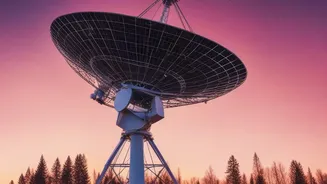
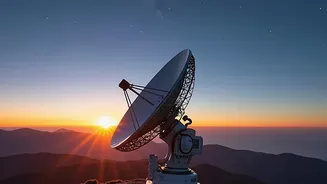
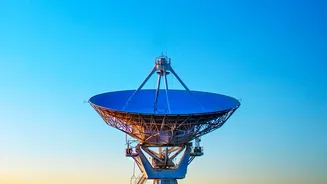
The Square Kilometre Array (SKA) is not a single instrument, but a revolutionary concept for a telescope. It is an international effort to build the world's largest radio telescope, eventually having a collecting area of over one square kilometre. Instead
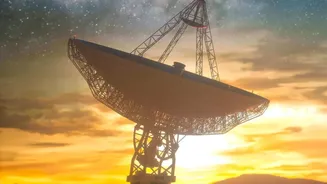
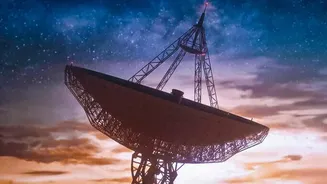
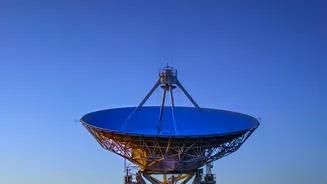
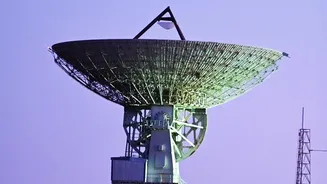
of one giant dish, the SKA will use thousands of antennas spread across two continents. The project is co-located in the remote, radio-quiet deserts of South Africa and Australia. South Africa will host the SKA-Mid array, consisting of hundreds of dish antennas that will observe the mid-frequency radio spectrum. Meanwhile, Australia is home to the SKA-Low array, a vast collection of over 131,000 smaller, Christmas-tree-like antennas designed to capture low-frequency radio waves. This dual-site approach allows the telescope to cover an enormous frequency range, far surpassing any existing facility.
Unprecedented Power and Scale
The sheer scale of the SKA is difficult to comprehend. Once complete, it will be able to survey the sky thousands of times faster than any current telescope. Its sensitivity will be so great that it could detect an airport radar on a planet tens of light-years away. This power comes from a technique called interferometry, where signals from many smaller antennas are combined to simulate a single, gigantic telescope with exceptional detail and resolution. The data generated by this vast network will be immense, potentially exceeding the entire daily traffic of the global internet in its later stages. Processing this data requires some of the fastest supercomputers in the world, driving innovation in high-performance computing, data management, and machine learning.
Tackling The Universe's Biggest Mysteries
The SKA's primary mission is to tackle some of the most fundamental questions in science. Astronomers will use it to peer back in time to the 'Cosmic Dawn', the period just after the Big Bang when the very first stars and galaxies began to form. It will also conduct the most precise tests of Einstein's theory of general relativity by studying pulsars and gravitational waves. Furthermore, the telescope will play a key role in the study of dark matter and dark energy, the mysterious components that make up about 95% of our universe. By mapping the distribution of hydrogen in billions of galaxies, the SKA will help us understand these invisible forces. And, of course, it will join the search for extraterrestrial life, listening for faint technological signatures from distant star systems.
India's Crucial Role
India is a full member of the SKA Observatory (SKAO), the intergovernmental organisation managing the project, marking a significant commitment to this global scientific endeavour. The Indian government has approved ₹1,250 crore to support the country's participation until 2031. Indian scientists and engineers have been involved since the project's early days, with the Pune-based National Centre for Radio Astrophysics (NCRA) leading a consortium of 24 institutions. A key contribution has been the development of the Telescope Manager, the complex software 'brain' that will control and operate the entire telescope system. This involvement not only places India at the forefront of astronomical research but also spurs domestic technological innovation and skill development.
A New Dawn for Discovery
Construction of the SKA began in December 2022, marking the culmination of decades of planning by scientists and engineers across 20 countries. As the arrays in Australia and South Africa gradually come online through the late 2020s, they will begin a new chapter in our exploration of the universe. Beyond pure science, the SKA project is a catalyst for innovation, with technologies developed for the telescope already finding applications in fields like medical imaging and computing. History shows that when we build tools to see the universe in new ways, we invariably discover things we never expected. The SKA is not just a bigger telescope; it is a new window on the cosmos, promising a flood of discoveries that could reshape our understanding of our place in the universe.