







What Are Orbital Data Centres?
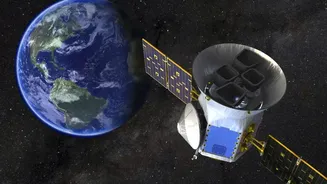
The servers and hardware that power our digital lives are housed in massive, power-hungry buildings called data centers. The idea behind an orbital data center is to take that infrastructure and place it in low Earth orbit. Companies like Thales Alenia
Space are exploring this concept with projects such as ASCEND, funded by the European Commission. The main drivers are efficiency and security. In space, solar panels can provide near-constant power, and the vacuum offers a free, highly effective cooling system, addressing two of the biggest costs and environmental impacts of ground-based data centers. Placing them in orbit could also offer ultra-secure data storage, physically disconnected from terrestrial threats.
From Satellites to Megaconstellations
A single data-processing satellite isn't enough to provide a global service. To create a true 'in-space cloud', companies would need to launch a 'megaconstellation' — a network of hundreds or thousands of interconnected satellites working together. We've already seen this model with broadband services like SpaceX's Starlink, which involves thousands of satellites to provide internet coverage. A data center constellation would function similarly, creating a resilient, globe-spanning network for data processing and storage. Some proposals are incredibly ambitious; one filing from SpaceX suggests a potential future network of up to one million satellites for an 'Orbital Data Center System' designed to power advanced AI applications.
The Growing Problem of a Bright Sky
Even before the idea of orbiting data centers, astronomers have been raising alarms about the impact of megaconstellations on their work. These satellites, particularly in the hours after sunset and before sunrise, reflect sunlight back to Earth, appearing as bright streaks that move across the night sky. These trails can ruin long-exposure astronomical images, making it harder to study distant galaxies or detect potentially hazardous near-Earth asteroids. The sheer number of satellites already in orbit has led to a measurable increase in overall skyglow, effectively a form of light pollution that threatens both scientific research and our shared cultural heritage of a clear night sky.
Why Data Centre Satellites Could Be Worse
Astronomers are concerned that data center satellites could significantly worsen the problem. To manage heat, these satellites might need large, highly reflective surfaces called radiators. To power their computing tasks, they would require massive solar panels. Both features would make them exceptionally bright. Furthermore, some proposals involve placing these constellations in sun-synchronous orbits, where they are almost constantly illuminated by the sun, meaning they would reflect light throughout the night, not just at dusk and dawn. The scale is also a major concern; a network of tens of thousands—or even a million—large, bright satellites would be a dramatic change from the thousands currently in orbit.
The Search for Solutions and Regulation
The astronomy community and satellite operators are already in a dialogue to find solutions. For existing constellations, some companies have experimented with anti-reflective coatings and sunshades to darken their satellites. However, the effectiveness of these measures on potentially larger, more complex data center satellites is unknown. Advocacy groups are pushing for regulatory bodies like the U.S. Federal Communications Commission (FCC) to conduct thorough environmental reviews before approving licenses for these massive new constellations. They argue that international rules are needed to limit satellite brightness and manage the growing congestion in low Earth orbit to ensure space remains a sustainable resource for everyone.