



In the vastness of space, a tiny, fast-spinning rock is challenging our understanding of asteroids and comets. New research suggests 1998 KY26, a target for a future space mission, may be too warm to behave like a comet, adding a new twist to its story.
A Celestial Spinning Top
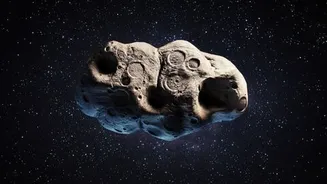
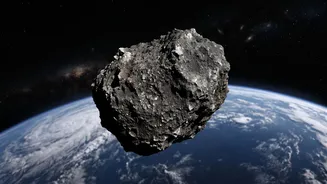
Meet 1998 KY26. Discovered in 1998, this near-Earth asteroid is remarkably small, measuring only about 11 metres (36 feet) in diameter—roughly the size of a school bus. But its size isn't what makes it so fascinating to scientists. It's the asteroid's incredible rotation speed. 1998 KY26 completes a full spin in just over five minutes, making it one of the fastest-rotating objects known in our solar system. This rapid rotation, combined with its small size, makes it a unique specimen for studying the physical properties of asteroids. These characteristics also make it the target for an ambitious extended mission by Japan's Hayabusa2 spacecraft, which is scheduled to rendezvous with the asteroid in July 2031.
The Asteroid-Comet Conundrum
Traditionally, the solar system's small bodies are separated into two main camps: rocky, inert asteroids and icy comets that release gas and dust as they approach the sun, creating a visible tail. However, astronomers have discovered hybrid objects, sometimes called 'active asteroids' or 'dark comets', that blur this line. These look like asteroids but exhibit comet-like activity, such as faint outgassing. Some scientists hypothesized that 1998 KY26 might be one of these dark comets. This theory arose because the asteroid shows a slight, unusual acceleration in its orbit that can't be explained by gravity alone, a phenomenon that could potentially be caused by the gentle push of escaping gases.
Too Hot to Handle Ice
A new study published in the journal Icarus has thrown cold water on the 'dark comet' theory. Researchers from the Georgia Institute of Technology created a detailed thermal model of 1998 KY26, calculating temperatures on its surface and in its interior. For an asteroid to hold onto buried water ice over long periods, it needs to stay incredibly cold—below about 145 Kelvin (-128 degrees Celsius). The new models show that even the coldest parts of 1998 KY26 have an average temperature of at least 212 Kelvin (-61 degrees Celsius). At these temperatures, any buried water ice would quickly turn into gas and escape, a process known as sublimation. The study calculated that if 1% of the asteroid's mass were ice, it would be gone in just over 2,000 years. If outgassing were causing the observed acceleration, the ice supply would be depleted in a mere 62 years.
Implications for a Space Mission
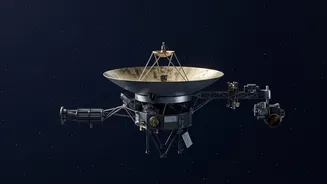
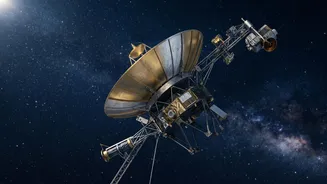
This finding has significant implications for Japan's Hayabusa2 mission. After its successful sample return from the asteroid Ryugu, the spacecraft is now on a decadelong journey to 1998 KY26. If the asteroid is indeed a dry, solid rock rather than an active, icy body, it changes what scientists might expect to find. The mission would shift from studying active outgassing to examining the properties of a tiny, monolithic, and extremely fast spinning asteroid—a first for any spacecraft. This makes the mission arguably more challenging but just as scientifically valuable. Understanding the structure of such a small, sturdy object is crucial for planetary defense, as it is comparable in size to the objects that caused the Tunguska and Chelyabinsk impact events.
An Enduring Mystery
While the new thermal model makes the presence of surface ice unlikely, it doesn't entirely close the case. It is unclear how long 1998 KY26 has been in its current orbit, so some ice could theoretically still remain from a past, colder journey. Other theories for its strange acceleration also exist, including the gentlebutpersistent push from solar radiation pressure. There is even a fringe hypothesis that its size, shininess, and unusual movement could mean it is not a natural object at all, but a piece of longlost space hardware like the failed Soviet Phobos 1 probe from 1988. Ultimately, the only way to solve the puzzle is to go there. The Hayabusa2 spacecrafts arrival in 2031 promises to finally give us a closeup look and answer the question of what 1998 KY26 truly is.