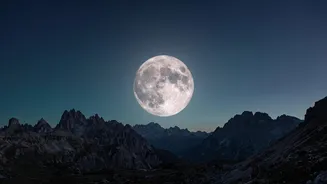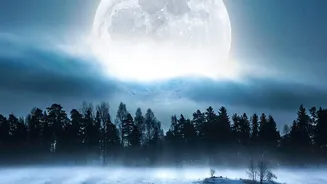


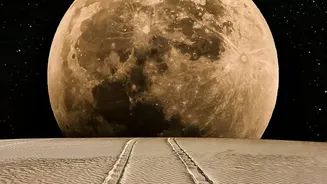


We’ve all seen it: a full Moon rising over a distant treeline or cityscape, looking so enormous you could almost touch it. But a few hours later, high in the sky, it seems to have shrunk. So what gives? It’s not an atmospheric trick. It's all in your
head.
An Illusion as Old as Stargazing
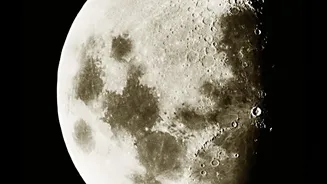
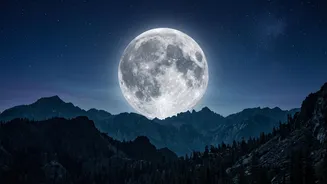
First, let's get one thing straight: the Moon does not physically change size as it travels across the sky. If you were to take a photograph of the Moon at the horizon and another when it's directly overhead, its diameter in both images would be virtually identical. You can even prove this yourself. The next time you see a giant horizon Moon, hold a small object like a pea or a pencil eraser at arm's length to cover it. Try it again when the Moon is high in the sky; the same small object will cover it just as easily. This phenomenon is called the Moon Illusion, and it's a powerful trick of perception that has puzzled thinkers from Aristotle to NASA scientists. It's not a physical process but a cognitive one, rooted in how our brains interpret the visual information they receive.
The Ebbinghaus Effect: It's All Relative
The headline's culprit, the Ebbinghaus illusion, offers one of the most compelling explanations for the Moon's perceived size change. You've likely seen it before: take two identical circles. Surround one with much larger circles and the other with much smaller circles. The central circle surrounded by the tiny circles will appear significantly larger than the one surrounded by the big circles, even though they are the same size. This simple test reveals a fundamental rule of our perception: our brain judges an object's size based on the context of its surroundings. It's a game of relativity, not absolute measurement.
Putting the Moon in Context
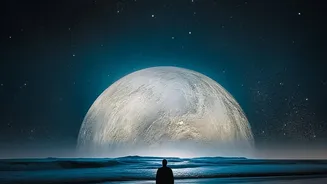
Now, let’s apply this to the sky. When the Moon is low on the horizon, it's surrounded by familiar objects that provide a sense of scale—trees, buildings, and mountains. From our perspective, these earthly objects are 'small' visual cues in comparison to the vast celestial body. Our brain sees the Moon next to these tiny reference points and, just like in the Ebbinghaus illusion, concludes the Moon must be gigantic. When the Moon climbs high into the sky, it’s surrounded by the vast, dark, and mostly empty expense of space. This emptiness acts like the 'large circles' in the illusion, making the Moon appear smaller in comparison. There's nothing nearby to trick our brain into inflating its size.
Not the Only Trick Up Our Brain's Sleeve
While the Ebbinghaus illusion provides a strong framework, most scientists believe the Moon illusion is a complex phenomenon with multiple contributing factors. Another leading theory is the 'Ponzo illusion', often demonstrated with converging lines like railroad tracks. An object placed higher up on the tracks (closer to the horizon) appears larger because our brain assumes it must be farther away and compensates by scaling up its size. The 'Apparent Distance Hypothesis' works similarly, suggesting we perceive the sky as a flattened dome, with the horizon appearing much farther away than the zenith directly overhead. Since the Moon is actually the same size, our brain perceives the 'more distant' horizon Moon as larger to make sense of the conflicting information. While no single theory has been definitively proven to be the sole cause, they all point to the same conclusion: our brains are actively interpreting reality, not just passively recording it.