



Why Mountains Offer the Best Views
There are three key reasons why astronomers and stargazers flock to high altitudes. First, they escape the worst of light pollution. The glow from cities and towns can brighten the sky so much that it drowns out all but the brightest stars. Remote mountain
ranges are naturally darker. Second, altitude gets you above a significant portion of the Earth's atmosphere. The atmosphere, with its turbulence and particles, distorts and dims starlight, which is why stars appear to 'twinkle'. Thinner, cleaner air at high elevations means a crisper, more stable view. Finally, these locations are often drier. Water vapour in the air can obscure views, particularly for infrared astronomy, so the arid conditions found in high-altitude deserts are perfect.
Hanle, Ladakh: India's Dark Sky Capital
Nestled in the Changthang plateau at a breathtaking altitude of 4,500 metres, Hanle is the crown jewel of Indian astro-tourism. In 2022, it was officially designated as India's first Dark Sky Reserve, a protected area dedicated to preserving its pristine night skies. The region is home to the Indian Astronomical Observatory, one of the world's highest, a testament to the exceptional clarity of the air. For travellers, this translates to an overwhelming celestial experience. On a clear, moonless night, the Milky Way is so vivid it appears three-dimensional, stretching from horizon to horizon, and thousands of stars are visible to the naked eye. The best time to visit is from May to October for the clearest conditions.
Spiti Valley, Himachal Pradesh: A High-Altitude Desert Haven
Often called a 'cold desert', Spiti Valley in Himachal Pradesh is another premier destination for stargazers. With villages like Kaza, Kibber, and Langza situated at elevations over 3,800 metres, you are well above the haze and clouds. The region is in a rain shadow, meaning it receives very little rainfall and boasts over 250 clear nights a year, making it a reliable bet for celestial observation. The experience in Spiti is not just about the sky but also the landscape; imagine seeing the arc of the Milky Way behind the thousand-year-old Key Monastery or the famous Buddha statue in Langza. It's a profound blend of natural wonder and ancient culture, offering some of the darkest, most accessible skies in Asia.
Coorg, Karnataka: Stargazing in the Southern Ghats
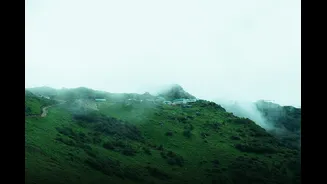
You don't have to travel to the Himalayas for a stellar view. The rolling hills and coffee plantations of Coorg (Kodagu) in Karnataka offer a surprisingly good escape from city lights. While the altitude isn't as extreme, many areas around Madikeri and Virajpet sit at 900-1800m and enjoy dark skies. It’s an accessible option for those in Southern India. Outside of the monsoon season (June to September), the post-monsoon months through to May offer excellent, clear nights. The winter evenings are particularly spectacular, with the constellation Orion and its famous nebula dominating the southern sky. Many homestays and resorts have open areas perfect for setting up a small telescope or simply laying back and watching the stars.
Mukteshwar & Kausani, Uttarakhand: The Kumaon Connection
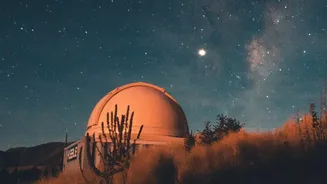
The Kumaon region of Uttarakhand has become a hub for accessible astro-tourism. Towns like Mukteshwar and Kausani offer a fantastic balance of clear Himalayan skies, good infrastructure, and professional guidance. Several private observatories have been established here, offering visitors the chance to look through powerful telescopes with expert commentary. These locations are easier to reach than the more remote high-altitude deserts but still provide a significant improvement in sky quality over the plains. They are perfect for a weekend trip for those looking for their first serious stargazing experience, offering guided sessions and workshops that make the cosmos accessible to everyone.