




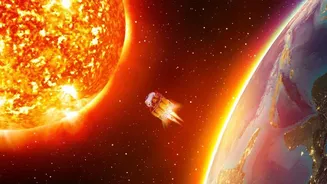
The Sun’s Violent Outbursts
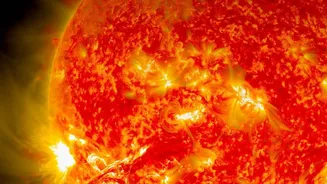
The Sun, our life-giving star, has a turbulent side. It periodically erupts, spewing enormous clouds of charged particles and magnetic fields into space. These events are known as coronal mass ejections (CMEs). When a CME is aimed at Earth, it can trigger
a geomagnetic storm — a major disturbance of our planet's protective magnetic field. These storms aren't just a curiosity for scientists; they are a direct threat to the technological backbone of modern society. A less intense but faster-moving threat comes from solar flares, which are intense bursts of radiation that can reach Earth in just minutes. While our atmosphere protects humans from direct harm, our technology is far more vulnerable. The Sun's activity waxes and wanes in an approximately 11-year cycle, with periods of 'solar maximum' seeing a sharp increase in the frequency and intensity of these storms.
A Threat to Our Connected World
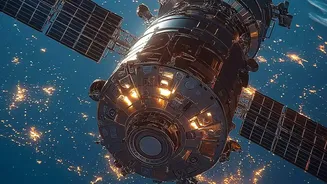
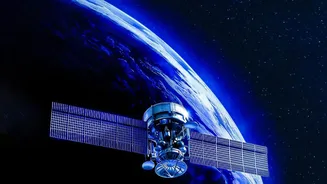
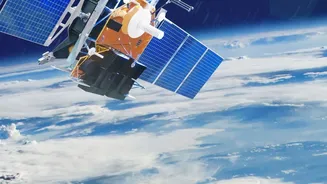
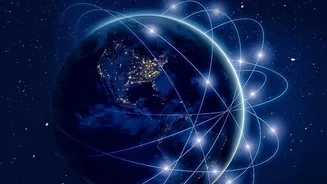
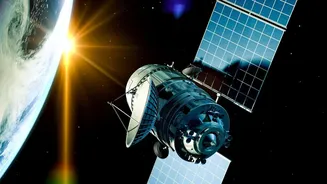
Imagine a world where the internet is down, GPS signals are lost, and widespread power blackouts last for weeks or even months. This isn't science fiction; it's the potential consequence of a severe solar storm. Geomagnetic storms can induce powerful, uncontrolled currents in long conductors like power transmission lines. These geomagnetically induced currents (GICs) can flow into transformers, causing them to overheat, saturate, and even fail, potentially triggering a cascading collapse of the power grid. In March 1989, a relatively moderate storm knocked out power for the entire province of Quebec for nine hours. Satellites, which are crucial for everything from GPS navigation and financial transactions to television broadcasting, are also at high risk. Energetic particles can damage their sensitive electronics, while the storm's effect on the upper atmosphere can increase drag, causing satellites to slow and lose altitude.
Our Eyes on the Sun
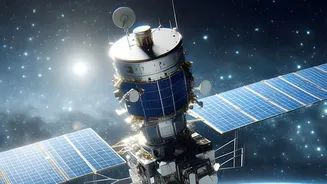
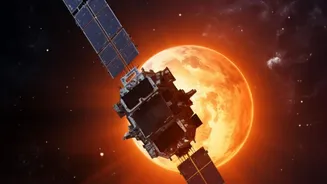
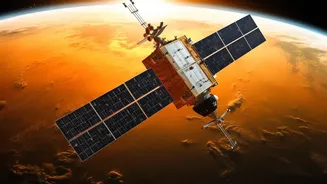
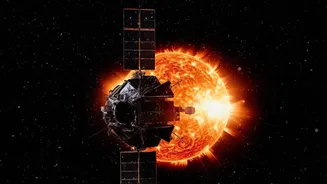
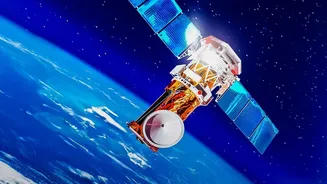
The key to protecting our infrastructure is early warning. This is where a global network of solar observatories, both on the ground and in space, comes in. Spacecraft like NASA's Solar Dynamics Observatory (SDO) and the joint NASA/ESA Solar and Heliospheric Observatory (SOHO) provide a constant watch on the Sun. A crucial vantage point is Lagrange Point 1 (L1), a spot 1.5 million kilometres from Earth where a satellite can maintain a stable position with an uninterrupted view of the Sun. India's Aditya-L1 mission, stationed at L1, is a powerful new tool in this effort. Its payloads observe the Sun across multiple wavelengths, studying everything from the solar corona to the solar wind, providing critical data for space weather forecasting. Recent findings from Aditya-L1 have even identified small brightening events that can act as an early warning sign hours before a major flare erupts.
From Warning to Action
Once forecasters at agencies like NOAA's Space Weather Prediction Center (SWPC) detect an Earth-directed CME, they issue alerts. A CME can take anywhere from 18 hours to several days to reach Earth, giving us a precious window to prepare. With this advance notice, power grid operators can take protective measures. This might involve reducing operating levels, rerouting power flows, or temporarily taking certain transformers offline to prevent overload and damage. Satellite operators can put their spacecraft into a protective 'safe mode,' turning off non-essential systems to minimise the risk of electronic damage. Airlines may also reroute flights away from polar regions, where the effects of space weather are strongest and can disrupt communication and navigation systems. The goal is not to stop the storm, but to intelligently manage our systems to weather its impact.
A Lesson from History
The most powerful geomagnetic storm ever recorded, the Carrington Event of 1859, provides a sobering benchmark. It created auroras visible as far south as the Caribbean and caused the global telegraph system — the high-tech network of its day — to fail catastrophically. Telegraph operators reported receiving electric shocks and sparks flying from their equipment, with some systems continuing to operate even after being disconnected from their power sources. If a storm of that magnitude were to strike our far more electrically dependent world today, the consequences would be devastating, with estimated economic losses running into billions of dollars per day and potential for long-lasting damage to critical infrastructure. This historical event serves as a stark reminder of why continuous monitoring and mitigation strategies are not just an academic exercise, but a national and global necessity.