





Saturn Shines at Its Brightest
October kicks off with a brilliant display from the ringed planet, Saturn. On October 4, it reaches opposition, meaning Earth is directly between Saturn and the Sun. This alignment makes it appear at its biggest and brightest for the entire year, visible
all night long as a steady, yellowish-white point of light. While you'll need a telescope to see its famous rings, Saturn's commanding presence in the night sky is easily appreciated with the naked eye. Look for it in the constellation Pisces. Throughout the month, it will be one of the most prominent objects in the evening sky, rising around sunset and remaining visible for hours.
The Draconid Meteor Shower
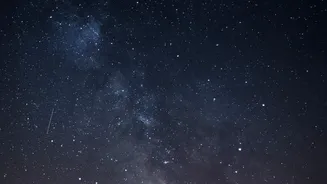
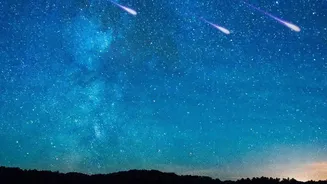
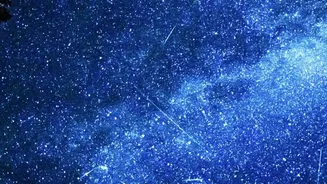
Get ready for the first of two meteor showers this month. The Draconid meteor shower is active from October 6 to 10, peaking on the night of October 8-9. Unlike many other showers that are best viewed after midnight, the Draconids are best seen in the early evening, just after full darkness sets in. This year's viewing conditions are excellent because the peak coincides with a nearly new moon, meaning darker skies will make it easier to spot the meteors. The shower is typically modest, producing about 5 to 10 slow-moving meteors per hour, but it's known for occasional, unpredictable outbursts. These meteors are fragments of the comet 21P/Giacobini-Zinner.
The Orionid Meteor Shower: A Gift from Halley's Comet
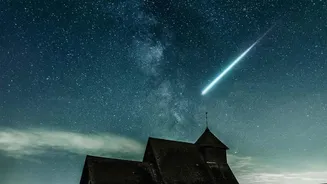
The more famous of October's showers, the Orionids, will peak on the night of October 21-22. These meteors are particles of dust and ice left behind by the one and only Halley's Comet. The Orionids are known for being fast and bright, often leaving persistent trails that can linger for a few seconds after the meteor has vanished. At its peak, you can expect to see between 15 and 25 meteors per hour in a dark sky. While a bright waxing gibbous moon will be present for part of the night, it sets in the early morning. This creates a perfect window for viewing from about 3 a.m. until dawn, when the sky will be dark and the shower most active.
The Hunter's Moon Rises
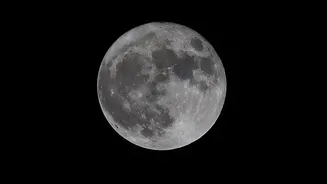
This month's full moon, known as the Hunter's Moon, will rise on the evening of October 25 and reach its peak illumination in India on the morning of October 26. The name is a nod to ancient traditions when this bright, post-harvest moon provided extra light for hunters preparing for winter. The best time to watch is during moonrise on the evening of the 25th, when it appears largest and often takes on a beautiful golden or orange hue as it climbs above the horizon. This impressive sight is caused by viewing the moon through more of Earth's atmosphere, and it's a perfect photo opportunity that requires no special gear.
A Dance of the Moon and Planets
October also features several beautiful close approaches, or conjunctions, involving the Moon and bright planets. On October 5 and 6, you can spot the waning crescent Moon pass near Mars and a very bright Jupiter in the pre-dawn sky. Later, on October 12 and 13, a thin crescent Moon will have a close encounter with Venus and Mercury low on the western horizon just after sunset, though this may be challenging to spot. These celestial groupings offer a lovely, serene sight and a great way to identify the planets without needing a star chart.