





Meet the Brain's 'Little Brain'
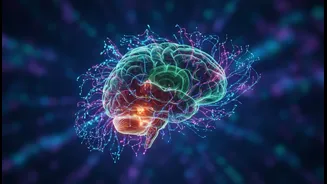
Tucked away at the back of your skull, beneath the large cerebral hemispheres, is the cerebellum. Often called the 'little brain', it has long been known as the master of coordination. Every step you take, every time you reach for a cup of coffee, or even
just stand upright, the cerebellum is working tirelessly, ensuring your movements are smooth, balanced, and precise. For decades, scientists viewed it primarily as a motor control autopilot, responsible for executing well-practiced actions without conscious thought. This understanding, while correct, was incomplete. Neuroprosthetic research, which aims to connect the brain to external devices, has historically focused on the motor cortex, the part of the brain that issues the initial commands for movement, largely bypassing the cerebellum.
The Secret to Learning and Adapting
The game-changing discovery is not that the cerebellum controls movement, but how it does so. Recent studies have revealed its crucial role in motor learning and adaptation—the process of fine-tuning our actions through trial and error. Think about learning to ride a bicycle. Your first attempts are clumsy and fall-ridden. With practice, you get better. That improvement is, in large part, driven by the cerebellum, which compares your intended movement with the actual outcome and sends 'error signals' to correct future attempts. Research from institutions like Cedars-Sinai has now explicitly demonstrated this function is essential for learning to use a brain-controlled device. Studies showed that when the cerebellum's activity was coordinated with the motor cortex, the ability to control a neuroprosthetic device improved dramatically. This makes the cerebellum not just an executor of commands, but a sophisticated learning machine.
The Challenge of Brain-Machine Interfaces
Brain-Machine Interfaces, or BMIs, are a beacon of hope for individuals with severe paralysis, such as that caused by spinal cord injuries or ALS. These systems work by recording brain signals, using a computer to decode the user's intention, and translating that intention into an action, like moving a cursor on a screen or controlling a robotic arm. However, a major challenge has been the sheer difficulty and time required for a user to master the technology. Traditional BMIs require immense concentration and lengthy training, as the user must learn to generate specific, consistent brain patterns that the algorithm can recognise. The control is often clunky, slow, and mentally exhausting, a far cry from the effortless nature of our own limbs. This is because the systems lacked a critical component: the ability to learn and adapt along with the user.
The Cerebellar Advantage in Engineering
This new understanding of the cerebellum as a learning engine is what has engineers so excited. Instead of building rigid decoders that need to be painstakingly calibrated, they can now create 'biomimetic' algorithms inspired by the cerebellum itself. These new-generation BMIs incorporate machine learning programs that simulate the cerebellum's error-correction function. The system doesn't just listen for a command from the motor cortex; it also monitors signals from the cerebellum to understand how to improve. If a user tries to move a robotic arm and overshoots the target, the algorithm registers this 'error'—much like the biological cerebellum would—and adjusts itself. This creates a synergistic, closed-loop system where both the human and the machine learn together, in real time. The result is a much faster learning curve for the user and a prosthetic that feels more intuitive and less like a tool to be wrestled with.
From Lab to a New Lease on Life
The practical implications are profound. For a person using a BMI-controlled prosthetic, this could mean the difference between a jerky, frustrating movement and a smooth, natural grasp. For someone communicating via a computer, it means faster and more accurate typing using only their thoughts. Recent research has shown that even when the motor cortex is damaged by a stroke, the cerebellum's signals alone can be harnessed to control a BMI, opening up possibilities for a whole new patient population. This work moves neuroprosthetics beyond simply bypassing a damaged spinal cord; it offers a way to work around a damaged brain by tapping into its other, incredibly adaptive, parts. It promises a future where technology doesn't just replace lost function, but integrates with the body's own remarkable capacity for learning and recovery, offering greater independence and a vastly improved quality of life.