






The Lure of Hidden Oceans
For decades, the search for life beyond Earth focused on rocky planets in the 'Goldilocks Zone'—not too hot, not too cold. But some of the most compelling targets in our own solar system are icy moons, far from the Sun's warmth. Two stand out: Jupiter’s
moon Europa and Saturn’s moon Enceladus. Evidence strongly suggests both harbour global oceans of liquid saltwater beneath their frozen surfaces. Unlike on Earth, the heat that keeps this water liquid doesn't come from the Sun, but from the immense gravitational pull of their host planets, which constantly squeezes and stretches the moons' interiors. This tidal heating could create hydrothermal vents on the seafloor, similar to those on Earth where vibrant ecosystems thrive without any sunlight, making these hidden seas prime candidates for life.
Europa: Jupiter's Great Water World
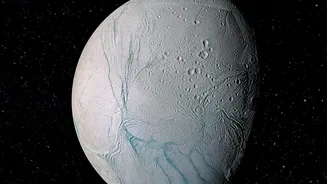
Europa is slightly smaller than Earth's moon but is thought to hold more than twice the amount of water as all of Earth's oceans combined. The primary evidence for its ocean comes from magnetic field data captured by the Galileo spacecraft, which detected a disturbance consistent with a global, conductive layer of salty liquid water. Its icy surface is also covered in cracks and reddish streaks, suggesting the shell shifts and that chemical-rich water from below may have welled up and frozen. NASA's Europa Clipper spacecraft, which launched in October 2024, is currently on its 1.8-billion-mile journey to the Jupiter system. Expected to arrive in April 2030, it will perform dozens of close flybys, but it won't land or drill. Instead, its goal is to confirm the ocean's existence, measure the ice shell's thickness, and identify potential sites for a future lander.
Enceladus: Saturn's Geyser Moon
While Europa’s ocean is still hidden, Enceladus offers a tantalising preview of its own. In 2005, the Cassini spacecraft discovered enormous plumes of water ice and vapour erupting from deep fissures near the moon's south pole, dubbed 'tiger stripes'. These geysers shoot hundreds of kilometres into space, giving scientists a direct sample of the ocean below. Analysis of this material by Cassini revealed water, salts, silica, and complex organic molecules—key building blocks for life. This makes Enceladus arguably the most accessible alien ocean we know of. Because of this, several missions have been proposed to return and investigate further, including NASA's Enceladus Orbilander concept and a potential mission from the European Space Agency. While still in early planning stages, these missions aim to orbit and eventually land on the moon to analyze its plumes for definitive signs of life.
A Toolkit for Remote Exploration
Peeking into an ocean buried beneath kilometres of ice is a monumental engineering challenge. You can't just send a submarine. Instead, missions like Europa Clipper are equipped with a suite of sophisticated instruments designed to act like a planetary-scale medical scanner. The Radar for Europa Assessment and Sounding: Ocean to Near-surface (REASON) instrument is designed to penetrate the ice with radio waves, mapping its thickness and searching for pockets of liquid water within the shell. A magnetometer will take more precise measurements of the magnetic field to confirm the ocean's depth and salinity. Meanwhile, advanced mass spectrometers, like MASPEX and SUDA, will analyze the chemical composition of any dust or gas ejected from the surface, sniffing for the faint chemical fingerprints of biological processes.
Searching for Biosignatures
These missions are not looking for alien fish. They're searching for 'biosignatures'—subtle clues that point to the presence of life. This could be specific organic molecules like amino acids in ratios that are unlikely to be created by non-biological chemistry, or evidence of microbes themselves. Recent studies suggest that if life exists, evidence in the form of these molecules could survive near the surface of both moons, especially Enceladus, where it could be found just millimetres deep. For Europa, sampling would need to go about 20 centimetres down to get below the zone of intense surface radiation. Amazingly, laboratory experiments have shown that modern instruments are so sensitive they could potentially identify cellular material in a single grain of ice collected from a plume.