





The Invisible World of Proteins
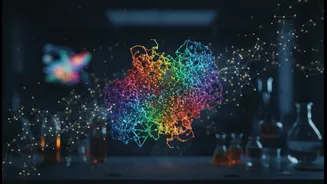
Proteins are the workhorses of life. They are complex, three-dimensional molecules that carry out nearly all cellular functions, from digesting food to fighting off viruses. A protein's shape is everything; it determines its job. Imagine a key fitting
into a lock. If a protein has the wrong shape, it can’t do its job, leading to diseases like Alzheimer's or cancer. For drug developers, understanding a protein's precise structure is the holy grail. A drug often works by targeting a specific protein, fitting into it like a custom key to either block its harmful action or restore its proper function. For decades, seeing these intricate structures has been a monumental challenge for scientists.
A Glimpse into the Frozen World
Enter cryo-electron microscopy, or cryo-EM. This Nobel Prize-winning technology allows scientists to see proteins in their natural, near-atomic detail. The process is like creating a microscopic flash-frozen diorama. Scientists take a sample of proteins, freeze it in liquid nitrogen to preserve its native state, and then blast it with a beam of electrons. A powerful detector captures thousands of 2D images of the proteins from different angles. Sophisticated software then pieces these images together to create a detailed 3D model. This technique revolutionized structural biology because, unlike previous methods like X-ray crystallography, it doesn't require scientists to coax proteins into forming crystals—a difficult, sometimes impossible task, especially for large or flexible molecules like those embedded in our cell membranes.
The AI-Powered Breakthrough
Cryo-EM was already a game-changer, but recent advancements have supercharged its capabilities, primarily through the integration of artificial intelligence. The latest breakthroughs focus on automating and accelerating the most time-consuming parts of the workflow. AI algorithms can now sift through massive datasets of blurry 2D images, accurately identifying individual protein particles and sorting them with incredible speed. This process, known as 'particle picking,' used to be a major bottleneck. Furthermore, AI is enhancing the final 3D reconstruction, sharpening blurry maps and even predicting how parts of a protein will fold, resulting in clearer and more accurate final structures. This fusion of AI and microscopy means researchers can get high-resolution structures faster and more reliably than ever before.
From Blueprint to Better Drugs
So, why does a faster, clearer picture of a protein matter? It dramatically accelerates the drug discovery pipeline, a process that is notoriously slow and expensive. With detailed 3D models, researchers can practice 'structure-based drug design.' They can see the exact nooks and crannies on a disease-causing protein and computationally design a small molecule that fits perfectly to neutralize it. This is a far more precise approach than the traditional method of screening millions of random compounds to see what sticks. The new cryo-EM advances are particularly vital for tackling previously 'undruggable' targets, such as the complex membrane proteins that act as gatekeepers for our cells and are implicated in countless diseases. In one instance, a cryo-EM structure was solved in just three days for a target that took two years with older methods.
An Era of Unprecedented Discovery
The impact of these technological strides extends beyond just one company or one drug. By making high-resolution imaging more accessible and efficient, these advances are democratizing a key tool for medical research. Scientists can now study the dynamic nature of proteins, capturing multiple conformations to understand how they move and function in real-time. This opens the door to designing smarter therapies for viral infections, like COVID-19, and neurodegenerative diseases. It provides crucial insights into drug resistance, allowing for the creation of next-generation therapeutics that can outsmart evolving pathogens or cancer cells. This isn't just an incremental improvement; it's a fundamental shift that equips the entire biomedical field to tackle diseases with unprecedented clarity and speed.