



The Universe's Most Reliable Clocks
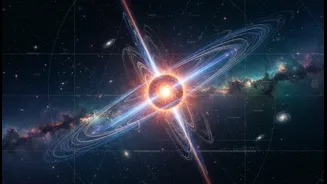
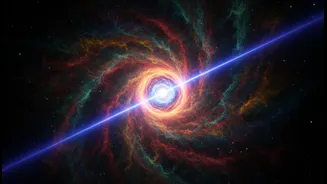
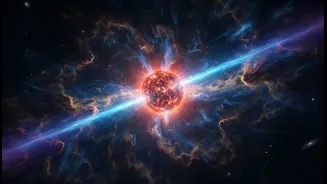
The key to this futuristic technology lies with pulsars, some of the most bizarre and fascinating objects in the cosmos. A pulsar is what's left after a massive star collapses and explodes. It's an incredibly dense neutron star, packing more mass than
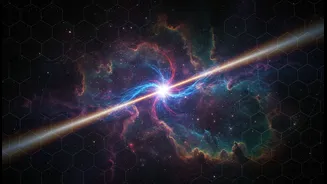
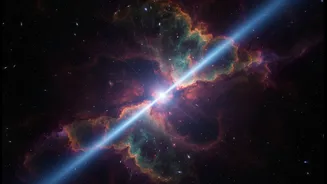
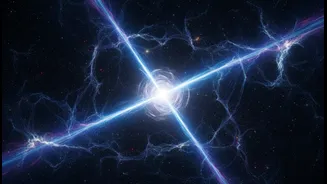
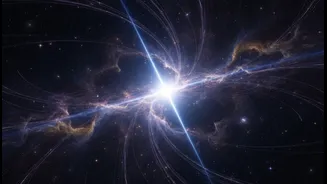
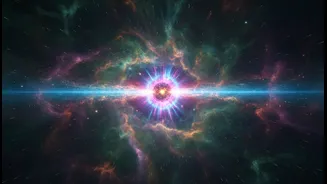
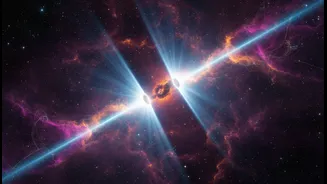
our sun into a sphere only about 20 kilometres across. These stellar remnants spin hundreds of times per second, sweeping beams of radiation, including X-rays, through space like a cosmic lighthouse. From Earth, we see these beams as pulses with a regularity so precise they rival atomic clocks. It's this clockwork timing that makes them perfect navigational beacons.
Building the Galactic GPS
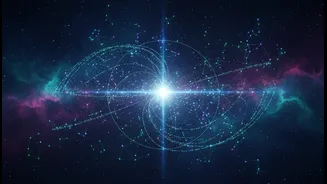
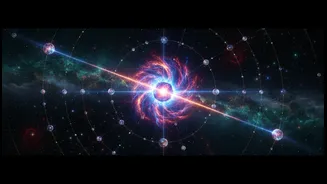
NASA's Neutron star Interior Composition Explorer (NICER), a telescope mounted on the International Space Station (ISS), is at the heart of this effort. In an experiment called SEXTANT (Station Explorer for X-ray Timing and Navigation Technology), scientists proved that by monitoring the X-ray signals from multiple pulsars, a spacecraft can calculate its own position autonomously. Much like how your phone uses signals from at least three GPS satellites, a spacecraft can triangulate its position by measuring the infinitesimal differences in the arrival times of pulses from different pulsars. In 2018, the SEXTANT team successfully located the ISS to within a few kilometres using this exact method, proving the concept works. This frees deep-space missions from their reliance on the Deep Space Network on Earth, which is both slow and oversubscribed.
A New Foundation for X-ray Astronomy
While autonomous navigation is the headline-grabbing application, a precise map of these pulsar lighthouses also provides a fundamental framework for X-ray astronomy itself. By creating a stable, galaxy-wide reference grid, astronomers can better calibrate their instruments and more accurately locate other X-ray sources in the sky. NICER's work has already led to the first-ever surface map of a pulsar, revealing that its 'hot spots' — the sources of the X-ray beams — are far more complex than textbook models predicted. Data from NICER shows these spots aren't always at opposite poles, challenging and refining our understanding of how these extreme objects function. This deeper knowledge improves all subsequent X-ray observations.
Testing Einstein in the Extreme
Pulsars are natural laboratories for testing the limits of physics. Their immense density and powerful gravity warp spacetime in ways that can't be replicated on Earth, making them perfect for testing Einstein's theory of general relativity. By timing the pulses from binary pulsars (two pulsars orbiting each other), scientists can measure how their orbits shrink over time. This decay is caused by the release of energy in the form of gravitational waves, and the measured rate has matched Einstein's predictions with incredible accuracy. The precision of the pulsar map allows for even more rigorous tests. For example, as a pulsar's spin axis slowly wobbles due to relativistic effects — a phenomenon called spin precession — the pulse shape we observe changes over years. Mapping this effect for a system called PSR J1906+0746 provided one of the most challenging and successful tests of general relativity to date.
The Future of Exploration and Science
The pulsar map is a dual-use technology with profound implications. For exploration, it promises a future of autonomous spacecraft that can navigate the solar system and beyond without having to 'phone home'. This increases mission security and efficiency, enabling more complex journeys to distant planets and asteroids. For science, it offers a new, sharper view of the high-energy universe and a tool for probing the very fabric of spacetime. Recent observations from NASA's IXPE telescope, for instance, have used pulsars to map the magnetic fields of their surrounding nebulae, confirming theories about how high-energy particles interact with interstellar gas. Each new pulsar added to the map makes this 'galactic GPS' more robust, solidifying the link between studying the distant cosmos and enabling our future within it.