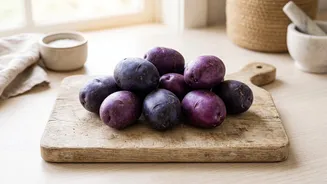






Imagine your everyday aloo, but with a vibrant purple twist, both inside and out. The Indian Council of Agricultural Research (ICAR) has turned this into a reality with Kufri Jamunia, a new potato variety that’s as striking as it is nutritious.
A Splash of Colour on Your Plate
Meet Kufri
Jamunia, a potato that breaks the mould of the typical white, yellow, or red spuds we know. Developed by the ICAR-Central Potato Research Institute (CPRI) in Shimla, this variety boasts a deep purple skin and, uniquely, a matching purple flesh. This distinct colour isn't just for show; it's a sign of the powerful nutrients packed within. Officially released in 2024, Kufri Jamunia is a 'biofortified' crop, meaning it has been specifically bred to have higher nutritional content to help combat micronutrient deficiencies, often called 'hidden hunger'. The name itself, referencing the 'jamun' fruit, hints at its rich, dark hue.
The Science Behind the Purple
The brilliant purple colour comes from natural pigments called anthocyanins, the same compounds that give blueberries, jamun, and other purple fruits and vegetables their colour. Anthocyanins are powerful antioxidants, which are believed to help protect the body's cells from damage. Kufri Jamunia contains a significant amount of these compounds—around 42 mg per 100 grams. But the benefits don't stop there. Compared to regular potatoes, it also has substantially more Vitamin C (about 42.75 mg), iron (3.22 mg), and zinc (2.28 mg) per 100g, making it a nutrient-dense choice for daily meals. This makes it a significant step up from previous coloured varieties like Kufri Neelkanth, which has purple skin but cream-coloured flesh.
An Indian Innovation for Indian Farms
Kufri Jamunia is a homegrown success story, developed through a cross-breeding program that began in 2015. Scientists at CPRI aimed to create a variety that was not only nutritious but also high-yielding and well-suited for Indian agricultural conditions. This medium-maturing variety takes about 90-100 days to grow and has shown a high yield potential of 32-35 tonnes per hectare in widespread trials. It has been recommended for cultivation across the northern, central, and eastern plains of India, covering major potato-growing states like Punjab, Haryana, Uttar Pradesh, Bihar, and West Bengal. This wide adaptability ensures that the benefits of this nutritious potato can reach a large population.
From the Kitchen to Your Table
So, how does it taste? Reports describe Kufri Jamunia as having a pleasant, earthy, and nutty flavour, similar to other allos purpose potatoes. It has a mealy texture, which makes it incredibly versatile in the kitchen. It's suitable for boiling, mashing, roasting, and frying, just like any other potato. While the vibrant purple colour may fade slightly during cooking, it still retains a lovely lavender hue, adding a visual pop to dishes like mashed potatoes, potato salads, or even homemade fries. Researchers have also noted its potential for creating value added products like nutrient rich flour, dalia (broken potato), and suji (semolina), opening up new culinary possibilities for this innovative vegetable.