





The Sun’s Unpredictable Temper
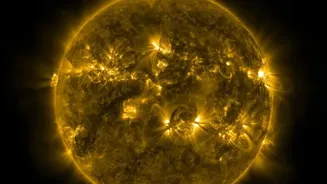
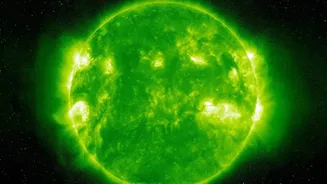
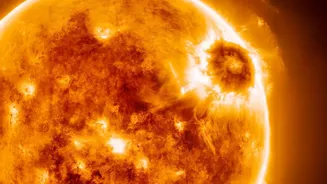
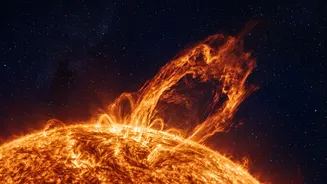
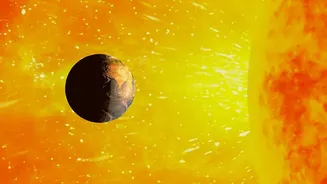
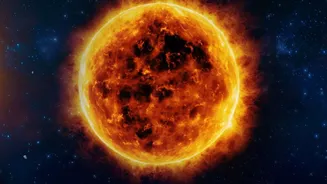
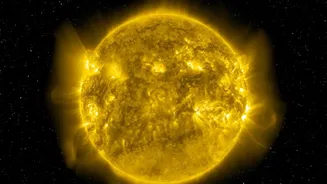
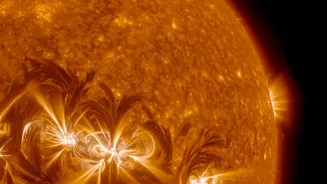
The Sun is not always the steady, life-giving star we perceive it to be. It constantly emits a stream of charged particles known as the solar wind. Occasionally, it unleashes massive explosions of energy, such as solar flares and coronal mass ejections
(CMEs), which hurl vast clouds of plasma and radiation into space. When these events are aimed at Earth, they can interact with our planet's magnetic field and trigger geomagnetic storms. These storms aren't just responsible for creating beautiful auroras; they pose a significant threat to our technological backbone. A severe event could induce electrical currents that overload power grids, leading to widespread blackouts, as happened in Quebec in 1989. It could also damage critical satellites, disrupting GPS navigation, global communications, and weather forecasting. Predicting the exact timing and impact of these storms has historically been a major challenge for scientists.
Introducing DAGGER: An AI Shield
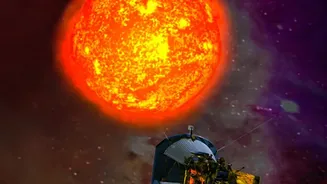
To address this vulnerability, an international team of researchers has developed a groundbreaking solution. As part of the Frontier Development Lab (FDL)—a public-private partnership including NASA, the U.S. Geological Survey, and private tech companies—they have created a new AI model designed to sound the alarm. The model is called DAGGER, which stands for Deep Learning Geomagnetic Perturbation. It uses a form of artificial intelligence called deep learning to analyze vast amounts of data from NASA spacecraft that monitor the solar wind. By training the AI on past events, DAGGER has learned to identify the subtle patterns in solar wind data that precede a geomagnetic storm on Earth. The lead author of a paper on the model, Vishal Upendran of the Inter-University Center for Astronomy and Astrophysics in India, noted that this AI makes rapid and accurate global predictions possible, helping to prevent devastation to modern society.
From Hours to Minutes: A Critical Upgrade
What makes DAGGER a game-changer is its speed and precision. While previous models could offer localised forecasts or slower global predictions, DAGGER is the first to combine the rapid analysis of AI with real-time satellite measurements to generate frequently updated and precise warnings for anywhere on Earth. The result is a reliable 30-minute advance warning before a solar storm strikes. This AI system functions like a global tornado siren for space weather, predicting the specific locations that will be hit the hardest. The model's effectiveness was validated by testing it against two past geomagnetic storms from August 2011 and March 2015, where it successfully forecasted the worldwide impacts with speed and accuracy. This half-hour window may not sound like much, but in the world of infrastructure protection, it can be the difference between stability and chaos.
Protecting Our Digital World
A 30-minute warning provides a critical window for action. Power grid operators could have just enough time to take preventative measures, like isolating transformers to prevent them from being overloaded by geomagnetically induced currents. Satellite operators could place their spacecraft into a protective safe mode to shield sensitive electronics from damaging radiation. Airlines could reroute flights, particularly those over the polar regions where the effects are strongest, to avoid communication blackouts and radiation exposure. With our society’s increasing reliance on technology, and as the Sun enters a more active phase of its 11-year cycle, the risk of a major space weather event is growing. Models like DAGGER represent a pivotal shift from simply enduring space weather to actively managing its effects, safeguarding the complex digital and electrical systems that underpin our daily lives.