


An Engine Deep Within
The source of this planetary shield lies thousands of kilometres beneath our feet. Earth's core is composed of a solid inner sphere and a liquid outer layer made of molten iron and nickel. As the planet spins, this superheated, electrically-conductive
liquid churns and flows, creating powerful electrical currents. This process, known as the geodynamo, transforms our planet into a giant magnet, generating a vast magnetic field that stretches far out into space. It is this field, called the magnetosphere, that forms our primary defence against extraterrestrial threats.
The Constant Solar Onslaught
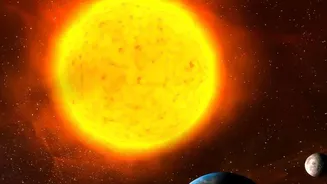
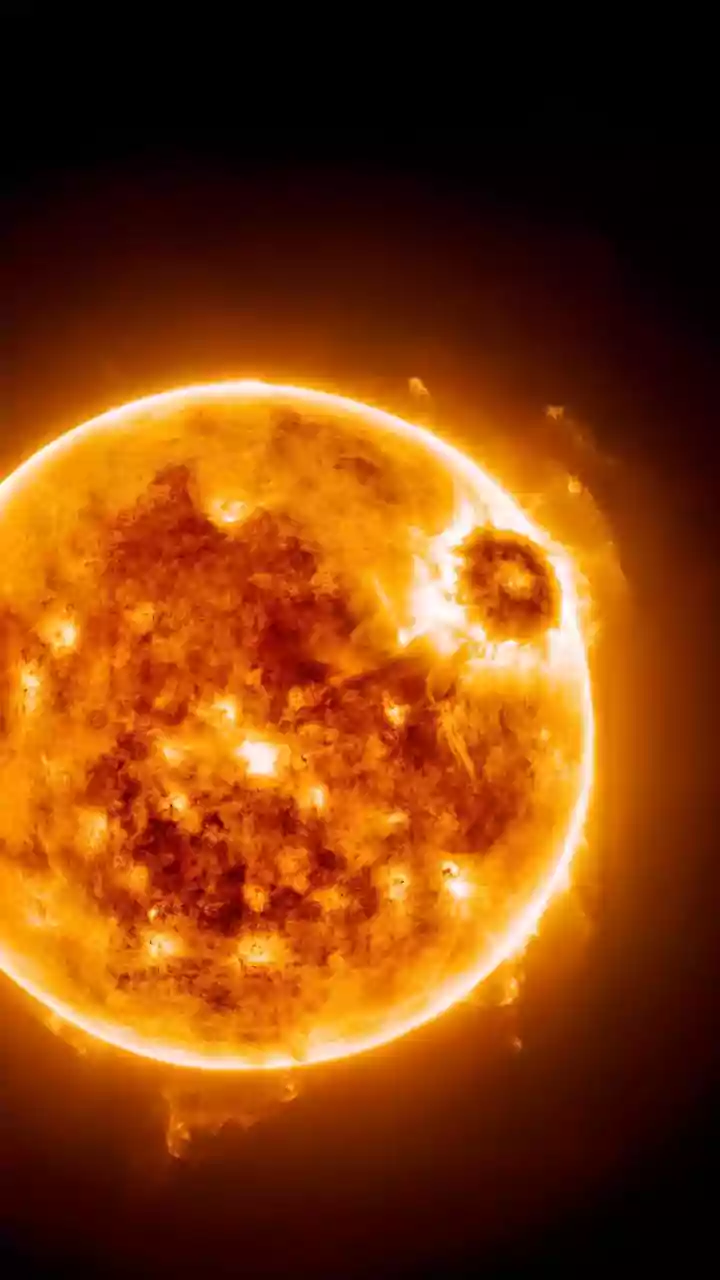
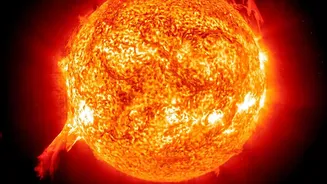
Our Sun, while essential for life, is also the source of a major threat: the solar wind. This isn't a wind in the earthly sense, but a continuous stream of charged particles—mostly protons and electrons—blasted from the Sun's corona at speeds of hundreds of kilometres per second. This plasma carries its own magnetic field and, if it were to directly strike our atmosphere, it would have the power to slowly strip it away, exposing the surface to deadly radiation. Scientists believe a similar process is what caused Mars to lose most of its atmosphere after its own magnetic field weakened billions of years ago.
The Mechanics of the Shield
When the charged particles of the solar wind and cosmic rays approach Earth, they encounter the magnetosphere. This acts like a cosmic buffer. The field lines deflect the vast majority of these particles, forcing them to flow around the planet instead of crashing into it. This interaction compresses the magnetosphere on the side facing the Sun and stretches it out into a long 'magnetotail' on the night side. The boundary where the solar wind's pressure is balanced by the magnetic field's pressure is known as the magnetopause, marking the outer edge of our planetary shield.
Cosmic Rays From the Void
Beyond the solar wind, Earth is also peppered with cosmic rays. These are much more energetic particles, often originating from violent cosmic events like exploding stars (supernovae) far outside our solar system. While the Sun's own magnetic field (the heliosphere) filters out many of these, our magnetosphere provides the crucial next layer of defence for those that get through. It deflects these high-energy particles, preventing them from reaching the surface where they could damage living cells and DNA.
A Glimpse of the Battle: The Auroras
Although the magnetic field is invisible, its effects are not. The spectacular auroras—the Northern and Southern Lights—are a beautiful side effect of this planetary defence system. Not all particles are perfectly deflected. Some become trapped and are funnelled along the magnetic field lines towards the polar regions. There, they collide with oxygen and nitrogen atoms in the upper atmosphere. These collisions excite the atoms, causing them to glow in vibrant curtains of green, red, and purple light, offering a stunning visual confirmation of our planet's invisible shield at work.
Life Under the Shield
Without the magnetosphere, Earth would be a vastly different and more hostile place. The constant bombardment of solar and cosmic radiation would not only pose a direct threat to life through increased cancer risks but would also erode our precious atmosphere and ozone layer over time. This would leave the surface exposed to harmful ultraviolet radiation from the Sun. Power grids, satellites, and communications technology would also be extremely vulnerable to damage from solar storms. Our planet's churning, molten core is ultimately what makes complex life on the surface possible, maintaining the stable and protected environment we depend on.