







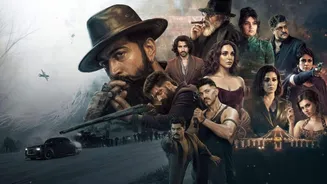
Sholay (1975): The Original Blueprint
Long before the term 'pan-Indian' was coined, there was Sholay. This Ramesh Sippy directorial, often described as a 'curry western', was a landmark in Indian cinema. With its star-studded cast featuring Dharmendra, Amitabh Bachchan, and the iconic villain
Gabbar Singh played by Amjad Khan, the film was a cinematic event. It redefined scale, action choreography, and storytelling, running in some theatres for years. Sholay's grand narrative of revenge and friendship, combined with its memorable dialogues and spectacular set pieces like the opening train sequence, created a template for the modern masala blockbuster. Its success was not just confined to the Hindi belt; it became a cultural touchstone across India, proving that a film with universal themes and high production values could capture the imagination of the entire country.
Roja (1992): The Cross-Cultural Bridge
Mani Ratnam's Roja was a game-changer for cross-cultural filmmaking in India. Originally a Tamil film, its story of a woman's desperate search for her husband, kidnapped by militants in Kashmir, was wrapped in a powerful patriotic theme. This emotional core, combined with A.R. Rahman's groundbreaking debut soundtrack, transcended linguistic and regional barriers. The film was dubbed into Hindi and several other languages, finding massive success nationwide. Roja demonstrated that a story rooted in a specific region could achieve pan-Indian appeal if its emotions were universal and its subject matter relevant to the national conversation. It revived the idea of a pan-Indian film by proving that dubbed versions could be massive commercial successes, paving the way for future directors to think beyond their local markets.
Enthiran (2010): The Technological Precursor
Before Baahubali's visual effects stunned audiences, director S. Shankar and superstar Rajinikanth delivered Enthiran (Robot). As India's most expensive film at the time, it was a sci-fi action spectacle on a scale previously unseen. The story of a scientist and his advanced android creation was packed with innovative special effects, futuristic concepts, and Rajinikanth's signature charisma in a dual role. Crucially, the film was released simultaneously in Tamil, Telugu, and Hindi, a strategic move that signaled a growing ambition to capture a national audience from day one. Its success demonstrated a clear appetite for high-concept, big-budget entertainers across the country and served as a crucial stepping stone in building the production and distribution infrastructure necessary for the modern pan-Indian epic.
Baahubali Series (2015-2017): The Game Changer
If earlier films opened the door, S.S. Rajamouli's Baahubali duology kicked it wide open. These films were not just dubbed; they were conceived and marketed as pan-Indian events from the very beginning. The epic fantasy saga of Mahishmati, with its warring brothers and grand mythology, was a visual spectacle that set a new benchmark for Indian cinema. The cliffhanger ending of the first film created a nationwide frenzy, making the sequel, Baahubali 2: The Conclusion, one of the highest-grossing Indian films of all time. Baahubali proved that a film from a regional industry (Telugu) could not only compete with but also dominate the national box office, shattering the pre-eminence of Bollywood and solidifying the pan-Indian film as a viable and incredibly lucrative business model.
K.G.F: Chapter 1 (2018): The Model Replicated
Following the path forged by Baahubali, K.G.F: Chapter 1 from the Kannada film industry was a bold declaration of pan-Indian aspirations. Directed by Prashanth Neel, the film's hyper-stylized action, gritty storytelling, and the universal underdog appeal of its hero, Rocky (played by Yash), resonated with audiences across India. Released in five languages, it became the first Kannada film to achieve such widespread success, transforming Yash into a national star. K.G.F proved that the Baahubali model wasn't a fluke but a repeatable strategy. It showed that any regional industry with a compelling story, a charismatic hero, and ambitious production could capture the national imagination, further fueling the wave of blockbusters that now regularly cross linguistic lines.