






The Ultimate Safety Net
The final moments of any crewed space mission involve a fiery reentry through Earth's atmosphere, where the crew module travels at tremendous speeds. The only way to ensure a gentle splashdown is through a flawlessly executed parachute deployment sequence.
This is non-negotiable. For the Indian Space Research Organisation (ISRO), developing a domestic capability for this complex system was paramount for its Gaganyaan human spaceflight programme. This isn't just about a single parachute; it's about a multi-stage, redundant, and rigorously tested system designed to work perfectly under the most extreme conditions imaginable.
A Ten-Parachute Symphony
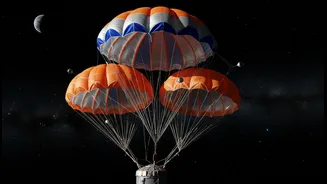
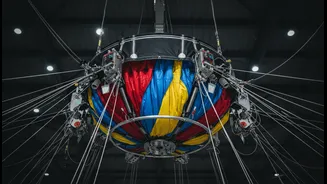
The deceleration system for the Gaganyaan crew module is a complex and carefully choreographed sequence involving 10 parachutes of four different types. The process begins when two Apex Cover Separation parachutes deploy to jettison the protective cover that shields the main chutes during reentry. Next, two Drogue parachutes are deployed. Their job is to stabilize the fast-moving capsule and significantly reduce its velocity. Once the module is stable, three smaller Pilot parachutes open to pull out the three massive Main parachutes. These main canopies are responsible for the final braking, slowing the module to a safe speed for its splashdown in the ocean. This entire sequence happens automatically, relying on precision engineering to perform each step at exactly the right moment.
Redundancy Redefines Safety
The key to the system's safety benchmark is its redundancy. While there are three main parachutes, only two are required for a safe landing. The third acts as a crucial backup, providing a significant safety margin in the unlikely event that one of the main chutes fails to deploy correctly. This commitment to redundancy demonstrates a core principle of human spaceflight: always having a backup plan. By building and successfully testing a system that can tolerate a major failure, ISRO is not just meeting international standards but establishing a new level of confidence in the safety of its astronauts.
Designed and Tested in India
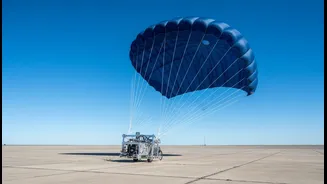
This advanced parachute system is a triumph of indigenous development, a collaborative effort between ISRO and the Defence Research and Development Organisation’s (DRDO) Aerial Delivery Research and Development Establishment (ADRDE) in Agra. To qualify the system, ISRO has conducted a series of extensive tests. In recent trials, a dummy mass equivalent to the crew module was dropped from an Indian Air Force IL-76 aircraft from an altitude of 2.5 kilometres to simulate the descent. These Integrated Main Parachute Airdrop Tests (IMAT) are designed to validate the structural integrity and reliability of the parachutes under maximum load conditions, providing crucial data and confidence ahead of the first uncrewed Gaganyaan mission.
The 'Ballistic' Advantage
The term 'ballistic' in the headline refers to the method of deployment. Instead of relying solely on airflow, the parachutes are ejected from their compartment using a rapid, controlled pyrotechnic or rocket-powered charge. This ensures the parachutes are forced out and begin to unfurl almost instantaneously, which is critical in high-speed emergency scenarios, such as an abort during launch. This rapid deployment method, proven in advanced aviation safety systems, adds another layer of security, ensuring the parachutes can do their job even when things go wrong at the most challenging moments of the mission. It’s this attention to detail in every possible scenario that truly elevates the safety benchmarks for the programme.