






Why Put Data Centres in Space?
The idea of launching data centers into orbit sounds like science fiction, but the rationale is grounded in very real terrestrial problems. On Earth, data centers are power-hungry giants, consuming enormous amounts of electricity and water for cooling.
This has led to community pushback and logistical hurdles in finding suitable locations with enough power. Proponents argue that space offers a compelling alternative. In a sun-synchronous orbit, satellites can be bathed in continuous sunlight, providing a near-unlimited source of solar power. This eliminates the need for massive terrestrial power grids and the associated carbon footprint. Furthermore, the vacuum of space offers a cooling solution that doesn't rely on fresh water, a significant environmental benefit. Companies like SpaceX, Blue Origin, and others are developing plans for these orbital facilities, envisioning them as a way to scale up AI capabilities without the earthly constraints.
A New Kind of Light Pollution
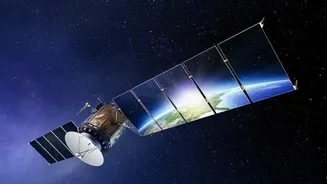
While the benefits are tantalizing, astronomers are raising alarms about a significant and potentially irreversible side effect: the pollution of the night sky. These proposed data centers would be massive structures, with some requiring solar arrays up to four-by-four kilometers in size to generate the necessary power. Due to their size and sun-synchronous orbits, they would reflect vast amounts of sunlight back towards Earth, particularly during the crucial twilight hours after sunset and before sunrise when many astronomical observations take place. A recent study co-authored by astronomers from several universities warns that if plans proceed without mitigation, the number of visible satellites could outnumber the stars by a factor of 100 at certain times. These objects wouldn't be faint specks; they would appear as bright, moving trails, potentially subtending an area nearly as large as the Moon. This would not only ruin the naked-eye experience of stargazing for the public but would also severely hamper scientific research, leaving bright streaks across sensitive telescopic images and obscuring faint, distant objects.
A Sky Already Too Crowded
The concern over orbital data centers is an extreme extension of a problem that already exists. The proliferation of 'mega-constellations' like SpaceX's Starlink, designed for global internet coverage, has already dramatically increased the number of artificial objects in low-Earth orbit. Astronomers report that images are increasingly streaked by satellite trails, and the aggregate light from all orbiting objects—including defunct satellites and space debris—has already raised the overall brightness of the night sky by at least 10% over natural levels. This exceeds the threshold set decades ago for what is considered a 'light-polluted' site. Adding potentially hundreds of thousands of new, much larger, and brighter data center satellites would exponentially worsen the situation. SpaceX alone has filed for up to one million satellites for its data center constellation, a number that would dwarf the approximately 16,000 active satellites currently in orbit.
Searching for a Compromise
The clash between technological ambition and astronomical preservation is forcing a difficult conversation. Can we have one without sacrificing the other? Mitigation efforts are being discussed, but the scale of the problem is unprecedented. For existing constellations, companies like SpaceX have experimented with darkening satellites to reduce their reflectivity, with mixed results. However, the sheer size of the proposed data centers makes them inherently more difficult to hide. The American Astronomical Society has urged regulators like the U.S. Federal Communications Commission (FCC) to reject applications until the impacts are fully understood and addressed. Meanwhile, international bodies like the UN's Committee on the Peaceful Uses of Outer Space (COPUOS) are beginning to formally address the issue, but regulatory frameworks are lagging far behind the pace of commercial development. Astronomers have suggested limiting the total number of satellites and setting strict brightness limits, but there is currently no global authority to enforce such rules.