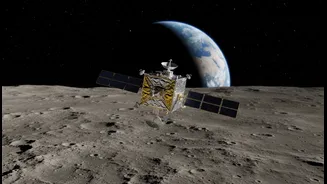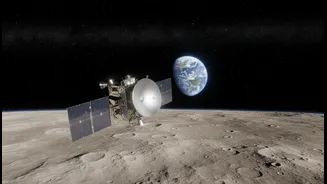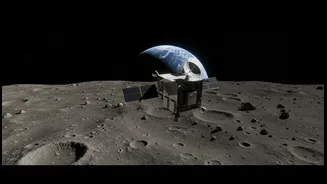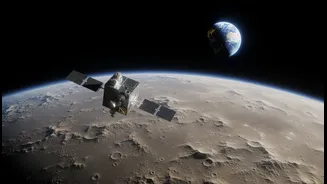




Meet CAPSTONE: The Little Spacecraft That Could
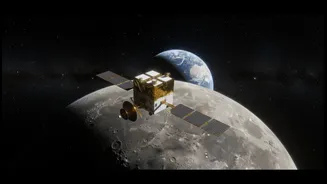
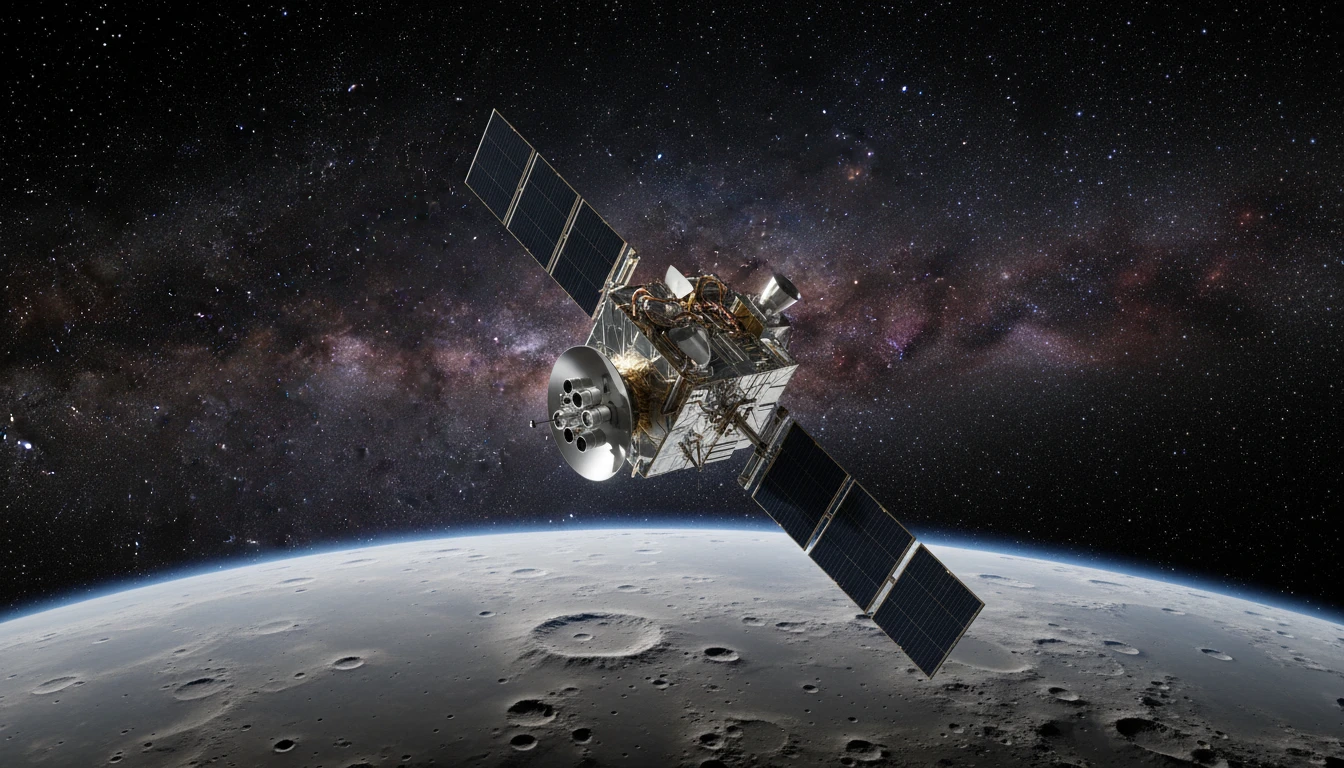
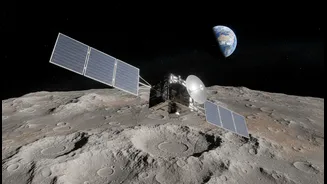
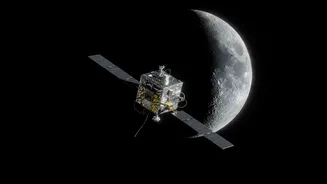
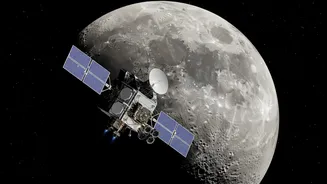
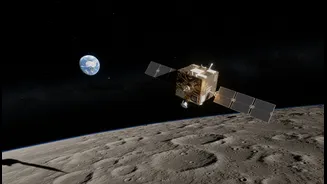
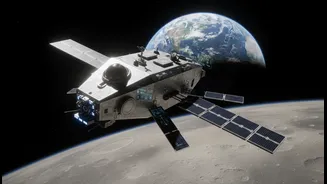
The mission at the heart of this breakthrough is called CAPSTONE, which stands for Cislunar Autonomous Positioning System Technology Operations and Navigation Experiment. Launched in June 2022, this microwave-sized spacecraft was the first commercial
mission to operate at the Moon. Its primary goal was twofold: to test a unique, fuel-efficient orbit and to prove that a spacecraft could navigate around the Moon without constantly 'phoning home' to Earth for directions. Developed in partnership with private companies like Advanced Space and Terran Orbital, CAPSTONE was designed as a low-cost pathfinder to reduce risks for future, more complex lunar missions.
Charting a New Path: The Halo Orbit
A key success of the CAPSTONE mission was being the first spacecraft to successfully enter and operate in a special path around the Moon called a near-rectilinear halo orbit (NRHO). This highly elliptical orbit is located at a precise balance point between the gravity of the Earth and the Moon. Think of it as a gravitational sweet spot. Spacecraft in this orbit require very little fuel to stay in place, making it an ideal staging area for long-term missions. The data gathered by CAPSTONE has validated this orbit for NASA's upcoming Gateway, a small space station planned for lunar orbit that will serve as a vital outpost for the Artemis program.
A GPS System for the Moon
Perhaps CAPSTONE's most influential achievement was testing autonomous navigation technology. For decades, spacecraft have relied on the Deep Space Network on Earth for tracking and guidance. CAPSTONE demonstrated a system that allows spacecraft to determine their own position. It did this by communicating directly with another satellite, NASA's Lunar Reconnaissance Orbiter (LRO), and using the signals to calculate its own location. This peer-to-peer system, called the Cislunar Autonomous Positioning System (CAPS), is a foundational step toward creating a true lunar navigation network, similar to the GPS we use on Earth. This capability will be essential for the Artemis missions, allowing landers, rovers, and even astronauts to navigate independently.
Smarter, More Resilient Communication
Beyond navigation, the mission also tested a smarter way to handle deep-space communications. Anyone who has dealt with a spotty internet connection can appreciate the challenge. In space, long delays and signal gaps are unavoidable. CAPSTONE successfully demonstrated delay/disruption tolerant networking (DTN). This system allows a spacecraft to store data when a connection is lost and automatically resume the transfer once communications are restored, ensuring every piece of data makes it home. This resilience is critical for building a reliable infrastructure to support a sustained human presence on the Moon.
Paving the Way for Artemis and Beyond
With all its primary and extended mission objectives achieved as of July 2026, NASA's official activities on CAPSTONE have concluded. The mission has provided a wealth of data that directly informs the Artemis program, which aims to land the first woman and first person of color on the Moon. By proving the stability of the NRHO and demonstrating autonomous navigation, CAPSTONE has lowered the risk for the Gateway station and for the astronauts who will travel to the lunar surface. The technologies it pioneered will allow for more efficient, safer, and more autonomous operations, not just at the Moon, but for eventual crewed missions to Mars.