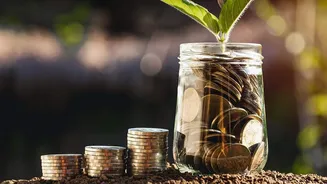







What is This 'Magic' Called Compounding?
At its heart, compounding is simple: it's the process of earning returns not just on your initial investment (the principal), but also on the accumulated interest from previous periods. Think of it as a snowball effect. Your initial savings are a small
snowball at the top of a hill. As it rolls, it picks up more snow (your returns). Soon, you have a bigger snowball, which then picks up even more snow, growing exponentially faster over time. This is what separates it from simple interest, which only ever pays you based on your original principal. Compounding turns your earnings into new workhorses, all generating their own returns. This is the engine of long-term wealth creation.
The Tale of Two Investors
To truly grasp the power of starting early, let's consider two friends, Priya and Rahul. Both want to save for retirement. Priya starts investing ₹5,000 every month at age 25. She continues this for just 10 years and then stops, having invested a total of ₹6 lakhs. Rahul waits until he is 35 to start. He also invests ₹5,000 a month, but he does it for the next 30 years, until he is 65. He invests a total of ₹18 lakhs—three times more than Priya. Assuming a conservative 10% annual return, who has more money at age 65? It’s Priya. Despite investing for only 10 years, her early start allows her money more time to compound. Her corpus would have grown significantly larger than Rahul's, who started later, even though he invested a much larger total amount. This is the stark reality of compounding: the time your money is invested is far more powerful than the total amount you invest.
Your 20s: The Ultimate Unfair Advantage
When you're in your 20s, you possess the single most valuable asset in investing: time. With a 30- or 40-year horizon until retirement, you give the compounding engine decades to work its magic. This long runway allows you to take on slightly higher-risk investments, like equities, which historically offer higher potential returns. Market downturns, which can be scary for those nearing retirement, are actually opportunities for a young investor to buy assets at a lower price. Furthermore, starting early instills financial discipline. Making small, regular investments a habit—just like paying for your streaming subscriptions—builds a foundation for a lifetime of financial wellness. Even if you start with a small amount, you can always increase it as your income grows.
How to Put Compounding to Work Today
The good news is that starting is easier than ever. You don't need a large lump sum. For most young Indians, the Systematic Investment Plan (SIP) is the perfect tool. A SIP allows you to invest a fixed amount of money—as little as ₹500 or ₹1,000—into mutual funds at regular intervals, usually monthly. This automates the process and removes the temptation to 'time the market'. When you invest a fixed amount regularly, you automatically buy more units when the market is down and fewer when it's up, a strategy known as rupee cost averaging. This disciplined approach, combined with the power of compounding, makes SIPs in diversified equity mutual funds one of the most effective ways for a beginner to build wealth over the long term. Opening a Demat account is the first step, and from there you can explore various mutual funds that align with your goals.