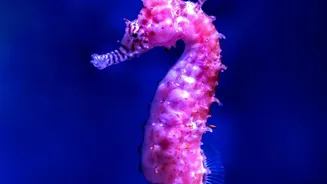



In the vast and varied animal kingdom, parental roles can be surprisingly flexible. But no creature flips the script quite like the seahorse, the only animal on Earth where the male undergoes a true pregnancy and gives birth to live young.
An Elaborate Courtship Dance
The reproductive
journey of a seahorse begins not with a simple transfer, but with a beautiful and complex courtship. For days, a male and female will dance together, often at dawn, intertwining their prehensile tails and swimming in synchrony. This elaborate ritual serves a crucial purpose: to align their movements perfectly for the main event. The male may show off his empty brood pouch, expanding it to demonstrate his readiness to receive her eggs. This dance can last for up to eight hours and culminates when the female deposits her unfertilized eggs directly into the male's pouch using an organ called an ovipositor. Once the transfer is complete, the male fertilizes the eggs inside his now-sealed pouch.
More Than Just a Carrier
The male seahorse's brood pouch is far from a simple incubator; it is a complex, placenta-like organ that actively nurtures the developing embryos. The inner lining of the pouch becomes rich with blood vessels, providing the embryos with essential oxygen and nutrients. It also manages waste removal and regulates the salinity of the internal environment, ensuring the conditions are perfect for the growing young, known as fry. This structure, which develops on the ventral side of the male's tail, is made of fused skin outgrowths and connective tissues that create a secure and life-sustaining environment for a pregnancy that can last from 14 to 28 days. Some species can carry as many as 2,000 babies at a time.
The Evolution of Male Pregnancy
Why did this remarkable role reversal evolve? Scientists believe it's a highly effective reproductive strategy. By having the male carry the pregnancy, the female is free to begin producing her next batch of eggs almost immediately. This division of labour allows a bonded pair to produce more offspring during a breeding season, increasing the species' chances of survival. In some cases, a male can give birth in the morning and be pregnant again by evening. This system also provides far greater protection for the eggs than in most other fish species, which often abandon their eggs after fertilization. The evolution of male pregnancy in seahorses and their relatives, like pipefish and seadragons, also required significant changes to the male's immune system to prevent it from rejecting the embryos as foreign tissue.
A Dramatic Birth
When the time comes for the fry to enter the world, the male seahorse undergoes a physically demanding labour. He experiences a series of muscular contractions, much like a mammal giving birth. Gripping a piece of seagrass with his tail, he will bend and jerk his body, using powerful skeletal muscles near the pouch opening to push the babies out. The process can last for hours as he expels his tiny, fully formed offspring into the water in powerful bursts. Though he provides this incredible level of prenatal care, his parental duties end there. The fry are left to fend for themselves, facing a perilous early life where only a fraction will survive to adulthood.