





Jio Platforms made a powerful debut on India's stock exchanges, listing at a significant premium after a record-breaking IPO. This massive influx of capital cements its status as a market titan, raising a crucial question for the industry.
A Listing for the Record Books
On October 28,
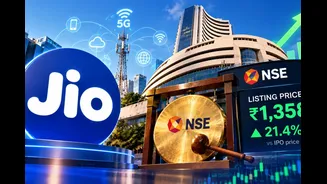
2026, Jio Platforms Ltd (JPL) launched India's largest-ever Initial Public Offering (IPO), raising over ₹30,000 crore. The issue was a resounding success, subscribed over 22 times and setting a global record with over one crore applications. Shares listed at ₹1,358, a 21% premium over the issue price, instantly making Jio Platforms India's second-most valuable company and the largest listed telecom firm, with a market capitalisation of around ₹12.5 lakh crore. This blockbuster listing not only injects massive financial firepower into the company but also formalises the immense valuation it had already built through private funding rounds with global tech giants like Google and Meta.
The Duopoly Deepens
The Indian telecom sector has been steadily consolidating into a duopoly, and Jio's listing accelerates this trend. The market is now a battleground between two giants: Reliance Jio and Bharti Airtel. As of September 2026, Jio leads with a 39.3% market share, while Airtel holds a close 38%. Together, they command over 77% of India's wireless subscribers. This leaves Vodafone Idea (Vi) in a distant third place with a 16.9% share, struggling to keep pace with the high capital expenditures of its rivals. While Vi has shown signs of stabilising, adding subscribers in recent months, the financial might of Jio, now further bolstered by its IPO, puts immense pressure on its ability to compete effectively in the long term, especially on 5G network expansion.
Fueling the 5G and Broadband Race
Expansion is no longer just about adding mobile subscribers; it's about dominating the next wave of digital infrastructure. India has seen one of the world's fastest 5G rollouts, with over 550,000 base stations deployed and coverage in nearly every district as of October 2026. Jio's financial strength is a critical advantage in this capital-intensive race. The company has aggressively expanded its 5G network and leads in Fixed Wireless Access (FWA) subscribers, a key strategy for capturing the home broadband market. Analysts expect Jio to leverage its war chest to accelerate its home broadband rollout and entrench its leadership, growing its base from 27 million in fiscal 2026 to a projected 66 million by 2029. This puts rivals on notice that the battle for India's digital future requires deep pockets.
Beyond Connectivity: The Digital Ecosystem
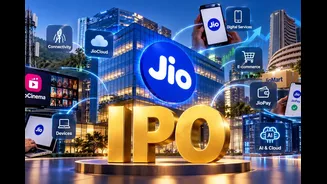
Jio's ambition has always extended beyond being a mere telecom operator. Its strategy is to build a comprehensive digital ecosystem, using affordable connectivity as the foundation to onboard users into a suite of services, including e_commerce (JioMart), media (JioCinema), and financial services. The IPO funds provide further impetus for this expansion. Analysts note that while digital services currently form a smaller part of revenue, this segment is expected to grow rapidly. This integrated approach means Jio isn't just competing with Airtel and Vi; it's positioning itself against a wide array of tech and media companies, aiming to capture a larger share of the Indian consumer's digital life and spending.
What Does This Mean for Consumers?
For Indian consumers, Jio's rise has been a double edged sword. It ushered in an era of ultra affordable data, making the internet accessible to hundreds of millions. Its aggressive 5G rollout promises to bring next generation speeds to the masses quickly. However, the consolidation of the market into a duopoly raises long term concerns. With less competition, the era of deep discounts is likely over. Brokerages anticipate industry wide tariff hikes of around $15%$ in the near future. While Jio's scale and efficiency may keep prices in check relative to global standards, the reduced number of major players could lead to higher prices and fewer choices for consumers down the line. The key question is whether regulatory oversight can ensure that this consolidated market remains competitive and continues to serve consumer interests.