




What Did Webb Actually See?
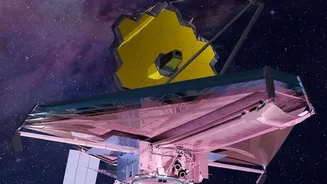
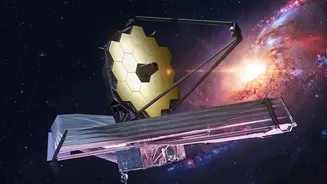
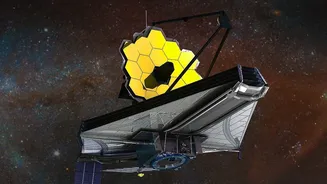
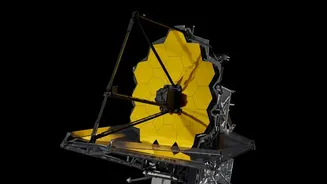
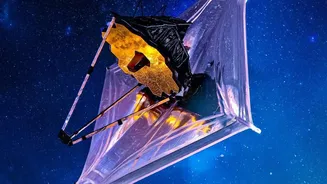
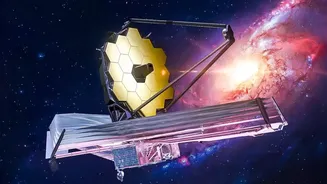
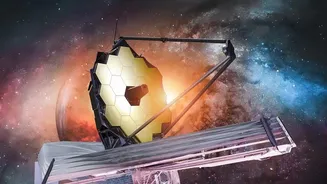
Astronomers pointed the powerful infrared eyes of the JWST toward the early universe and spotted what appeared to be two brilliant sources of light shining just 900 million years after the Big Bang. These objects are not stars, but quasars—some of the most
luminous and energetic phenomena in the cosmos. Officially named J1602+4228AB, the pair has been given the Hawaiian nickname Nāpōwawāʻenakaulua, meaning 'Two celestial bodies of fathomless powerful darkness in the brilliance of heat'. What makes this special is that they are a pair, and the oldest and most compact quasar pair ever found, separated by a relatively tiny cosmic distance of about 18,100 light-years.
Understanding Quasars
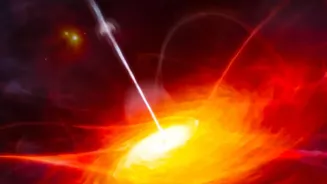
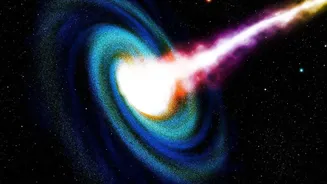
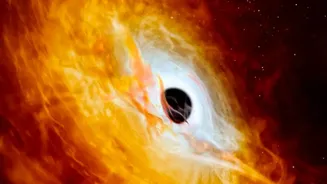
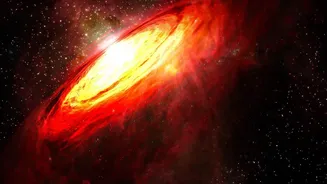
A quasar isn't an object itself, but rather a spectacular event. It’s the intensely bright core of a distant galaxy, powered by a supermassive black hole at its centre. As the black hole’s immense gravity pulls in surrounding gas and dust, the material forms a swirling, superheated 'accretion disk' around it. The friction and gravitational forces in this disk heat the material to incredible temperatures, causing it to glow with a brightness that can outshine entire galaxies, making them visible across billions of light-years. In essence, when you see a quasar, you are witnessing a black hole in the midst of a colossal feeding frenzy.
The Puzzle of Rapid Growth
One of the biggest mysteries in modern astronomy is how supermassive black holes grew to be so enormous, so quickly in the early universe. We see black holes billions of times the mass of our sun existing when the universe was less than a billion years old. Standard theories suggest that black holes grow by gradually merging with other black holes and accreting matter over vast stretches of time. However, this process is too slow to explain the cosmic behemoths observed in the cosmic dawn; there simply wasn't enough time for them to get that big. Finding a single one is a puzzle, but finding a pair like Nāpōwawāʻenakaulua is even more perplexing for existing models.
A Snapshot of a Cosmic Merger
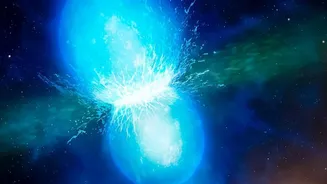
The discovery of this quasar pair provides a powerful piece of evidence for a leading theory: rapid growth is fueled by galactic mergers. When two galaxies collide, the gravitational chaos funnels enormous quantities of gas and dust towards their respective central black holes. This sudden, massive influx of fuel triggers a 'quasar phase', causing both black holes to light up as they grow at an accelerated rate. The Nāpōwawāʻenakaulua system is a direct snapshot of this very process in action. It's not just two quasars near each other, but likely two galaxies in the process of merging, with their central black holes on a path to eventually combine.
Rewriting the Universe's Story
This finding suggests that such violent, gas-rich mergers were a common and crucial feature of the early universe. Rather than a slow and steady process, the first supermassive black holes likely grew in intense, chaotic spurts driven by these galactic collisions. The two black holes in this system are estimated to have masses of 1.5 billion and 400 million times that of our sun, respectively—staggering sizes for such an early cosmic epoch. This observation acts as a vital data point, confirming that the chaotic, crowded conditions of the young cosmos provided the perfect environment for black holes to become supermassive in a hurry.