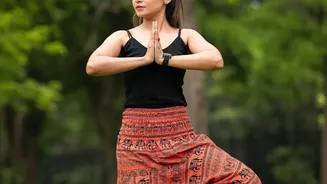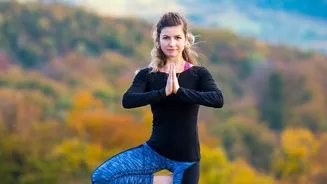



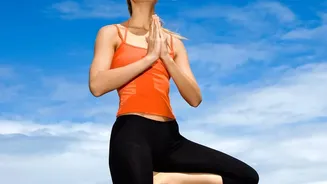

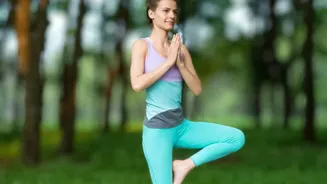
Vrikshasana, or Tree Pose, is a foundational yoga posture that builds strength, focus, and poise. But its true power lies not in achieving a perfect, rigid stance, but in the journey of finding stability through gradual, mindful progression.
Establish Your Roots
Before you
can grow branches, you must establish strong roots. Begin in Tadasana (Mountain Pose), standing tall with your feet about hip-width apart. Ground down through all four corners of your feet, feeling the connection to the earth. Engage your thigh muscles and draw your core in gently to create a stable trunk for your body. Fix your gaze, or 'drishti', on a non-moving point in front of you; this is crucial for maintaining your balance. Breathe steadily and deeply. This simple act of standing with intention is the first and most important step. Without this solid foundation, wobbling is inevitable.
First Steps: The Sapling Variation
For those new to the pose or feeling unsteady, the goal is to build confidence. Start by shifting your weight onto your left foot. Bend your right knee and open your hip out to the side. The first variation is to simply place the sole of your right foot against your left ankle, keeping the toes of your right foot on the floor like a kickstand. This gives you a feel for the hip-opening action without the full balance challenge. When you feel ready, lift the foot to your inner calf. The most important rule here is to always avoid placing your foot directly on the knee joint, as this can cause injury. Keep your hands at your heart in a prayer position (Anjali Mudra) or on your hips.
Growing Stronger: The Classic Tree
Once you can comfortably balance with your foot on your calf, you can progress to the classic expression of Tree Pose. From your rooted standing leg, use your hand to guide the sole of your lifted foot to your inner thigh. Actively press your foot into your thigh and your thigh back into your foot; this creates a dynamic tension that locks you into place and enhances stability. Ensure your hips remain level and squared to the front, resisting the urge to lean into your standing leg's hip. Hold here for several breaths, feeling the strength in your standing leg and the gentle opening in your bent hip.
Branching Out: Exploring Arm Variations
When your lower body feels steady, you can begin to challenge your balance by moving your arms. From the prayer position at your chest, inhale and gracefully raise your arms overhead, either parallel or with palms touching. You can also extend them out to the sides like wide branches. Introducing movement, like slowly swaying your arms from side to side as if in a gentle breeze, further tests your core stability and focus. Each new arm position subtly shifts your center of gravity, forcing the tiny stabilizing muscles in your standing leg and core to work harder.
Advanced Growth: The Half_Lotus Tree
For seasoned practitioners with open hips, the journey can lead to Ardha Padmasana, or Half_Lotus Tree Pose. This variation involves bringing the top of the lifted foot to rest on the opposite hip crease, with the sole of the foot facing upward. This is a deep hip opener and requires significant flexibility and control. It should only be attempted when you can hold the classic Tree Pose with complete ease and stability, and without any knee pain. This pose is not an end_goal, but another step in the ongoing practice of balance and concentration, reminding us there is always more to explore within our practice.
Navigating The Wobbles
Wobbling is not a sign of failure; it is your body learning to balance. If you feel unsteady, don’t be afraid to use a wall or chair for support. Even a light touch with one finger can provide the feedback your brain needs to find its center. Remember to keep breathing. Holding your breath causes tension and makes balancing more difficult. If you fall out of the pose, simply reset and begin again with patience. Some days your balance will feel solid, and other days it will be fleeting. The practice is about showing up and embracing the process, not achieving perfection.