




An Explorer's Storied Past
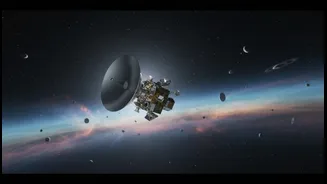
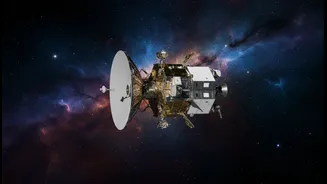
Launched in 2006, New Horizons is one of NASA's most celebrated planetary missions. It left Earth faster than any spacecraft before it, on a decade-long journey to a world we had never seen up close. In July 2015, it completed humanity's first flyby of Pluto,
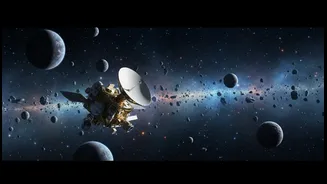
transforming the dwarf planet from a fuzzy pixel into a complex world with vast nitrogen-ice glaciers, a layered atmosphere, and hints of a subsurface ocean. Its primary mission complete, New Horizons journeyed deeper into the Kuiper Belt, a vast ring of icy bodies beyond Neptune. On New Year's Day 2019, it flew past Arrokoth, the most distant object ever explored by a spacecraft, revealing a primordial, snowman-shaped relic from the solar system's formation 4.5 billion years ago.
Waking Up in the Darkness
To survive its long voyages through the cold, dark expanse between targets, New Horizons relies on hibernation. Mission controllers power down most of its systems, leaving only essential functions active to monitor its health and save wear and tear on its components. The probe has hibernated 23 times since 2007, for periods ranging from days to many months. On July 7, 2026, NASA announced the spacecraft had successfully awakened from its longest nap yet—321 days—in perfect health. After spending so long in a low-power state, mission operators are now downloading the health data and scientific observations its instruments continued to gather while it coasted through the Kuiper Belt, an incredible 9.5 billion kilometers from Earth.
The Solar System's Final Frontier
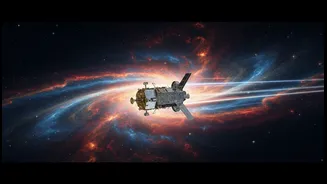
The "border" New Horizons is now tasked with mapping is a vast, invisible bubble called the heliosphere. This bubble is created by the solar wind, a constant stream of charged particles flowing outward from the Sun at supersonic speeds. This wind travels far beyond the planets, carving out a cavity in the interstellar medium—the gas and dust that fills the space between stars. Eventually, this solar wind slows down as it collides with interstellar material and is pushed back, forming a boundary. This boundary isn't a simple line; it's a complex, dynamic region with a termination shock, a transitional area called the heliosheath, and a final edge known as the heliopause. Understanding this region is crucial, as it acts as a shield, protecting our solar system from a significant amount of high-energy galactic cosmic rays.
A Unique Vantage Point for Science
This is where New Horizons' wakeup becomes so significant. While the legendary Voyager 1 and 2 probes crossed this boundary in 2012 and 2018 respectively, they are now nearly 50 years old and their instruments are from the 1970s. New Horizons is equipped with more modern scientific tools, allowing it to make measurements the Voyagers couldn't. For instance, its SWAP instrument can measure "pickup ions," which are created when interstellar neutral particles sneak into our solar system and become ionized, a key process that slows the solar wind. Furthermore, the Voyager probes are traveling in different directions through the heliosphere. New Horizons provides a third, unique data point, allowing scientists to build a more complete, three-dimensional picture of this distant boundary for the first time. This multi-point observation is what makes the mapping effort truly unprecedented.
What We Hope to Learn
By combining data from New Horizons with the aging Voyager probes, scientists hope to answer fundamental questions about our place in the galaxy. Is the heliosphere shaped like a comet with a long tail, or is it more like a symmetrical bubble? How does its shape change during the Sun's 11-year cycle of activity? The probe will actively measure the solar wind, dust, and energetic particles, charting how the Sun's influence diminishes with distance. As it continues its journey, expected to exit the Kuiper Belt around 2028 or 2029, it will provide an early warning for when it's approaching the termination shock. These observations are not just about mapping our own cosmic backyard; they help us understand the astrospheres around other stars and the very nature of how stellar systems interact with their galactic environment.