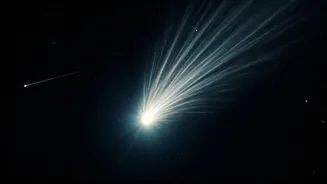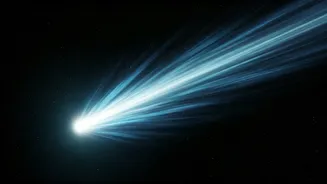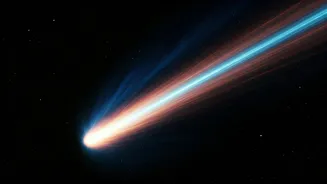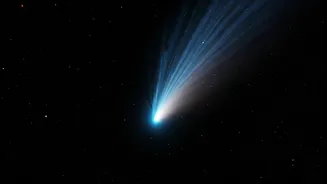







A Visitor From Another Star
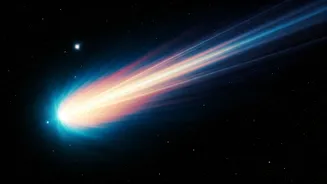
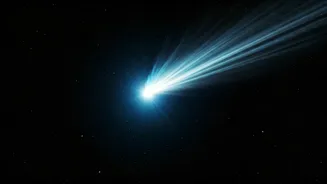
It’s a story that feels like science fiction, but it is very real. Astronomers are currently tracking an object named 3I/ATLAS, which was confirmed to have come from a completely different star system. It was first spotted on July 1, 2025, by the NASA-funded
ATLAS survey telescope in Chile. Moving at a blistering speed of roughly 135,000 miles per hour, its path through space is so unusual that it could only have originated from outside our solar system, making it a true interstellar visitor. This is only the third such object ever detected, following the discoveries of the mysterious 'Oumuamua in 2017 and the comet 2I/Borisov in 2019.
What Makes an Interstellar Object Special?
Most objects we see in the night sky, like the comets and asteroids that occasionally grace our view, are natives of our own solar system. They were born from the same cloud of gas and dust that formed our Sun and planets. An interstellar object, however, is a cosmic wanderer. It formed around a different star, was likely ejected from its home system, and has been travelling through the vast emptiness of the Milky Way galaxy for potentially billions of years. The arrival of 3I/ATLAS is like receiving a message in a bottle from a distant, unknown shore. It provides an unprecedented opportunity for scientists to study material from another planetary system up close.
A Frozen Time Capsule
Unlike the first interstellar visitor, 'Oumuamua, which was gone too quickly to study in detail, 3I/ATLAS has been identified as a comet. It has a fuzzy cloud, or coma, around its nucleus, which is a tell-tale sign of ice turning to gas as it gets closer to the Sun. This is incredibly exciting for scientists. By using powerful instruments like the James Webb Space Telescope, they can analyze the chemical makeup of this gas. Recent studies have revealed that 3I/ATLAS has a unique chemical signature, with a high amount of 'heavy water' that suggests it formed in an extremely cold environment, possibly making it one of the oldest objects ever seen in our solar system.
The Global Scientific Chase
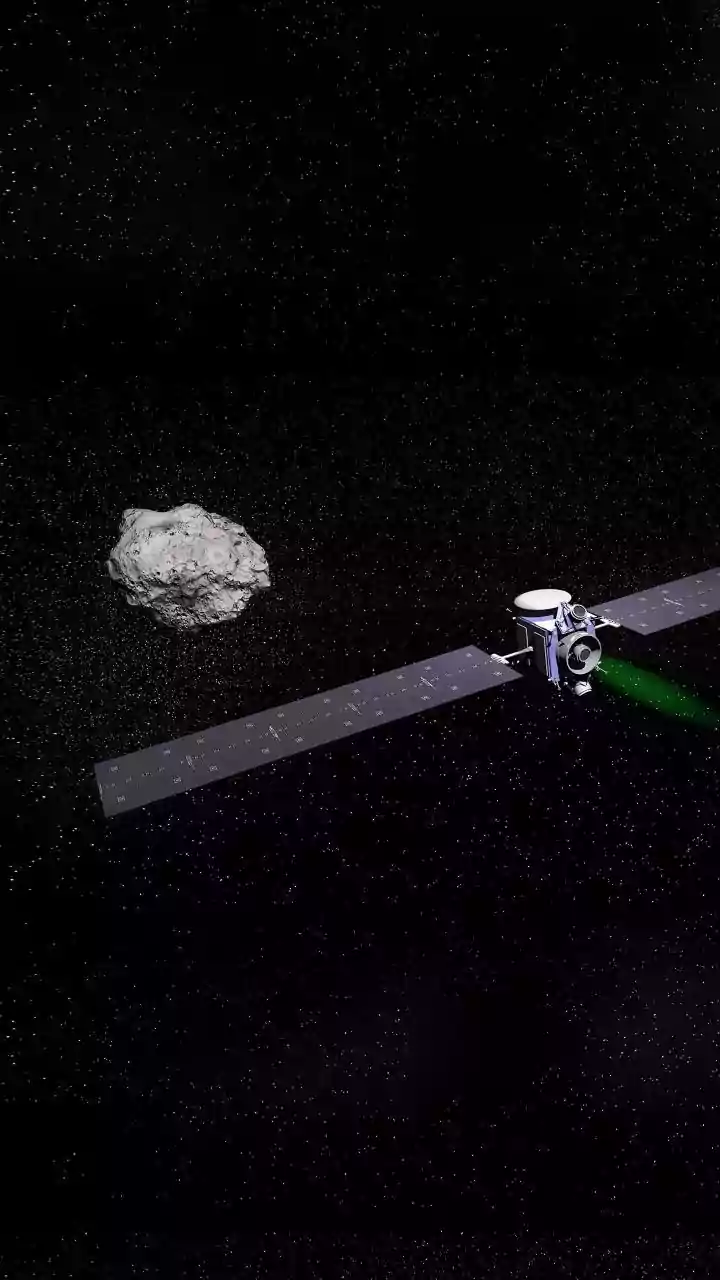
The discovery of 3I/ATLAS triggered a global campaign, with telescopes all over the world turning to get a look at the visitor before it disappears forever. The object made its closest approach to the Sun in late October 2025 and is now on its way out of our solar system, never to return. While there was some playful speculation about alien origins, a thorough scan by the SETI Institute found no evidence of any technological signals. The focus for the global scientific community, which includes Indian researchers involved in major sky surveys, is to gather as much data as possible. Every observation helps build a clearer picture of how planets and comets form not just in our solar system, but across the galaxy.