
The Conventional Way: Propulsive Landings
For years, the world has watched in awe as SpaceX's Falcon 9 boosters have returned from the edge of space to land vertically on concrete pads or autonomous droneships at sea. This method, known as propulsive landing, involves reigniting some of the booster's
own engines to slow its descent, deploying landing legs, and touching down gently. This reusability was a breakthrough, dramatically lowering the cost of access to space. The Falcon 9 system proved that rockets didn't have to be single-use machines. However, after landing, the boosters need to be secured, transported back to a facility, inspected, and prepared for their next flight—a process that still takes time.
Starship: A New Scale Demands a New Strategy
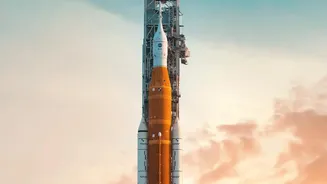
Enter Starship, the colossal, next-generation launch vehicle designed to carry humans to Mars. Comprising the Super Heavy booster and the Starship spacecraft, the entire stack stands over 120 meters tall. The sheer scale and mass of the Super Heavy booster meant that simply scaling up the Falcon 9's landing legs would be inefficient. The legs would need to be massive and heavy, cutting directly into the rocket's payload capacity—the amount of cargo it can carry to orbit. Every kilogram of rocket structure is a kilogram that can't be used for satellites, supplies, or crew. This fundamental problem pushed SpaceX engineers to a radical new solution: what if the landing gear wasn't on the rocket at all?
Meet 'Mechazilla': The Tower-Catch System
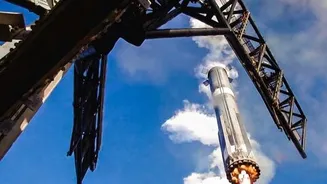
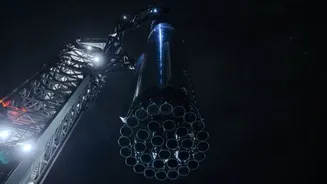
SpaceX's solution is a 146-meter-tall launch integration tower nicknamed 'Mechazilla'. Attached to this tower are two massive, movable arms, often called the 'chopsticks'. The recovery process is a high-stakes mechanical ballet. After separating from the Starship upper stage, the Super Heavy booster performs a flip and a 'boostback burn' to reverse course and fly back to the launch site. Using its grid fins to steer, it targets the launch tower. In the final moments of its descent, it fires its engines to slow down to a near-hover. This is where the chopsticks come in. The arms close around the booster, catching it by reinforced hardpoints near the top before it ever touches the ground.
The Advantage: Speed and Mass Savings
The primary driver for this complex strategy is rapid reusability. By catching the booster directly with the tower, SpaceX can immediately lower it back onto the launch mount, ready for inspection, refueling, and the stacking of a new Starship upper stage. The goal is to reduce the turnaround time from weeks or months to a matter of hours, enabling an 'airline-like' launch cadence. This is crucial for ambitious missions like colonizing Mars, which would require dozens of launches in a short window to send a fleet of tankers to refuel a Mars-bound Starship in orbit. The second major advantage is the weight saved by removing landing legs entirely. That mass is instead allocated to the ground system, which can be built to be far more robust without worrying about the penalty of launching it into space.
An Audacious, High-Risk Maneuver
The tower-catch strategy is not without immense risk. The precision required is extraordinary; the booster must arrive at the correct altitude, velocity, and orientation for the arms to make a successful catch. A failure could be catastrophic, potentially destroying not just the booster but also the entire launch tower and ground infrastructure, setting the program back significantly. The maneuver requires a perfect harmony between the booster's flight computers, its engines, its control surfaces, and the ground-based mechanical systems. Despite the risks, SpaceX has already successfully caught a Super Heavy booster on its first attempt, demonstrating the viability of the concept and marking a major step towards a fully and rapidly reusable launch system.