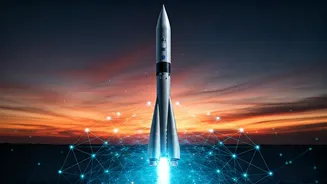










Beyond the Launchpad: India's New Space Age
For decades, the Indian space programme was synonymous with the government-led Indian Space Research Organisation (ISRO). While ISRO remains the backbone of the nation's space efforts, a major shift is underway. The opening of the sector to private companies
and the establishment of IN-SPACe, a single-window agency to promote and authorise private space activities, has ignited a startup boom. This has fundamentally changed the industry, dividing it into two main areas: 'upstream' and 'downstream'. Upstream involves the traditional work of designing and launching rockets and satellites. The downstream sector, however, is where the real explosion of opportunity lies. It’s all about using the data and services from those satellites to create applications for life on Earth.
The Data Gold Rush from the Stars
Every satellite orbiting Earth is a powerful data-gathering tool. This data is the raw material for a vast and growing industry, and it needs people who can make sense of it. Data scientists, AI and machine learning engineers, and GIS (Geographic Information System) specialists are now some of the most sought-after professionals in space-tech. They analyze satellite imagery and signals to power a host of services. These applications range from precision agriculture that helps farmers increase crop yields, to disaster management systems that provide early warnings for cyclones. They also support urban planning, help locate natural resources, and even power the navigation apps on your phone. This work doesn't require a degree in astrophysics; it requires expertise in data handling, programming, and analytics.
An Entire Ecosystem of Professionals
A thriving industry needs more than just technical experts. As hundreds of space-tech startups emerge in India, they are actively hiring for roles that you might find in any fast-growing tech company. There is a growing demand for business development managers to find new markets, finance experts to manage investments, and marketing professionals to build brands. The sector also requires lawyers who specialize in the complex field of space law and policy, as well as project managers and HR professionals to build and scale teams. Indian startups like Skyroot Aerospace and Digantara are not just hiring aerospace engineers; they are recruiting from allied fields like automotive and chemical engineering and then providing specialized training. This signifies a maturing ecosystem that values diverse skill sets.
Space Technology in Your Daily Life
The impact of space technology extends far beyond specialized industries and into our homes, often in ways we don't even realize. These are called 'spin-off' technologies. The memory foam in your mattress and pillows was originally developed by NASA to improve crash protection for astronauts. The scratch-resistant coatings on your eyeglasses came from research to protect astronaut helmet visors. Even everyday items like cordless power tools, home water filters, and infrared thermometers have their origins in technology developed for space missions. As India’s own private space sector grows, we can expect a new wave of homegrown innovations to find their way into our daily lives.